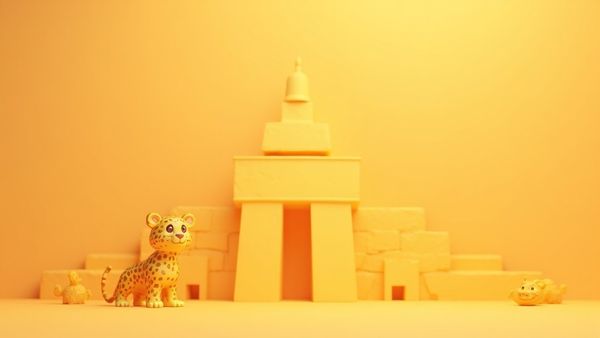
The Maya civilization was a highly advanced culture that flourished in Mesoamerica, building massive step-pyramids like those at Tikal and Chichén Itzá. They famously invented the concept of 'zero' using just three symbols. This shows how brilliant and scientifically advanced they were long ago!
Did you know there was a super advanced civilization in the rainforests of Central America that invented the idea of 'zero' long before many others? Get ready to explore the incredible Maya!
The Maya civilization was a brilliant group of people who lived in a region called Mesoamerica, which is now parts of Mexico, Guatemala, and neighboring countries. They started building their first cities around 750 BC, and their 'Golden Age' (called the Classical Period) was between about 420 AD and 900 AD! These amazing people weren't just good builders; they were also incredible thinkers, scientists, and artists. Let's dive into why history says the Maya were anything but boring for kids!

Mira says:
"I love how the Maya used simple dots and bars to write *any* number, even zero! It was like building with LEGOs, but for math!"
What Are the Maya Famous For Building?
The Maya were master builders! Their cities were filled with towering structures that reached for the sky. They built huge temples shaped like step-pyramids, massive palaces for their rulers, and special ball courts for exciting games.
These cities were the centers of life, handling things like government, trade, and religion. Some of their most famous cities were Tikal, Palenque, and Chichén Itzá, and you can still see the ruins today!
To move between different parts of their cities, they even built raised limestone roads called sacbeob (say: sack-BAY-ohb). Imagine building roads through a jungle without modern machines!
Mind-Blowing Fact!
The Maya people believed that their rulers were so important that they could talk directly to the Gods! The ruler of each city was seen as having a divine connection.
How Did the Maya Count and Write?
Get ready for some cool math! Unlike us, who use ten digits (0 through 9), the Maya used a Base-20 system, which is called vigesimal. This means they counted in groups of twenty, possibly by counting fingers AND toes!
They only needed three symbols to write any number: a dot (•) for one, a bar (—) for five, and a shell-shape for zero.
Instead of writing numbers side-by-side like we do (like 123), the Maya stacked their numbers vertically, starting at the bottom. The bottom row was the 'ones' place, the row above was the 'twenties' place (20x1), and the next row up was the 'four hundreds' place (20x20)!
The two main calendars synced up every 52 years!
Up to this many symbols in their writing system!
Population of a major Maya city at its peak.
New research suggests the Maya Lowlands held up to this many people!
How Did the Maya Keep Track of Time?
The Maya had one of the most accurate calendar systems ever created, all without telescopes! They watched the sky closely to track the Sun, Moon, and even planet Venus. They used this knowledge to create three main ways of tracking time.
The Maya had a religious calendar called the Tzolkʼin, which was a 260-day cycle. They also had a solar calendar called the Haabʼ, which had 18 months of 20 days, plus five extra, 'unlucky' days!
The Famous Long Count Calendar
To record history over long stretches of time, they used the Long Count Calendar. This calendar counted the days that passed starting from a mythical creation date: August 11, 3114 BC!
This calendar was so precise that it was used to track long cycles of history. Even though many people thought the world would end on December 21, 2012, that was just the end of one huge cycle called a bʼakʼtun—a new cycle just began!
💡 Did You Know?
The Maya wrote in a system called hieroglyphics! Each symbol, or glyph, could represent a sound or a whole word or idea. Their writing was the most advanced in the pre-Columbian Americas, but sadly, the Spanish burned most of their books (called codices), so we only have a few left!
🎯 Quick Quiz!
What three symbols did the Maya use to write ALL of their numbers?
Who Were the Maya People Today?
The Maya civilization didn't totally vanish! Even after the great cities in the lowlands declined around 900 AD, and after the Spanish arrived in the 1500s, the Maya people survived.
Today, descendants of the Maya still live in the same areas of Mexico, Guatemala, and Belize. Over five million people speak about 30 different Mayan languages!
- Staple Foods: They grew delicious things like maize (corn), beans, squash, and chili peppers.
- Special Drink: Cacao beans (which make chocolate!) were so important they were sometimes used as money!
- Housing: Most Maya lived in small homes with thatched roofs, often built on platforms to stay safe from floods.
From inventing the concept of zero to mapping the stars with incredible accuracy, the Maya civilization left behind a legacy of genius. They remind us that amazing innovations can happen anywhere in the world, at any time in history!
Questions Kids Ask About World History
Keep Exploring the Ancient World!
Wow, what an adventure through ancient Mesoamerica! The Maya prove that history is full of clever people doing incredible things. Keep listening to 'History's Not Boring' to uncover more amazing stories from the past!