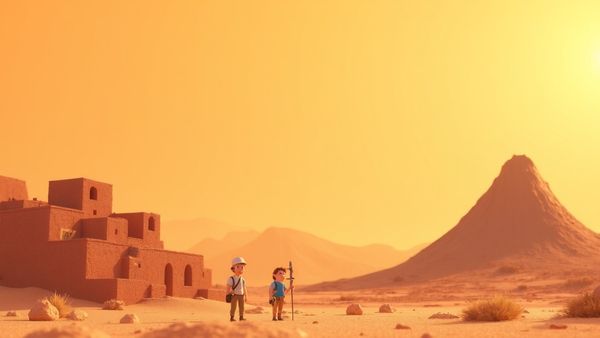
Pompeii was a bustling ancient Roman city buried by the catastrophic eruption of Mount Vesuvius in 79 AD. The volcano launched 1.5 million tons of rock per second, creating an ash cloud 21 miles high. About 10,000-20,000 people lived there before the disaster. Today Pompeii is a UNESCO World Heritage Site — a perfectly preserved time capsule of Roman life, from bread in the ovens to graffiti on the walls.
What if a whole city suddenly disappeared, only to be found nearly 2,000 years later, exactly as it was?
That's the incredible, yet super dramatic, true story of Pompeii! This bustling ancient Roman city, full of markets, homes, and busy streets, was thriving near the sunny coast of Italy. But then, the giant mountain nearby — Mount Vesuvius — decided to wake up! In 79 AD, this volcano erupted in a massive, terrifying explosion that buried Pompeii under layers of ash and rock. In this guide, you'll discover what life was like in this amazing Roman city, learn exactly what happened when Vesuvius erupted, meet the eyewitness who wrote it all down, and explore the incredible things archaeologists have dug up. Get ready to travel back in time!

Mira says:
"It's amazing! Imagine looking up and seeing the top of Mount Vesuvius just... *poof*... disappear into a giant cloud! Pliny the Younger wrote down everything he saw, which is how we know so much about this terrifying day."
What is Mount Vesuvius and Where is Pompeii?
Pompeii was a popular and rich city in the Roman Empire, located in a beautiful area called Campania, near the modern city of Naples in Italy. It was a wonderful place to live because the soil near the volcano was super fertile, making their farms grow amazing grapes for wine and olives for oil!
The mountain looming nearby is called Mount Vesuvius, and it's still an active volcano today. Scientists think that before the big eruption in 79 AD, the mountain might have been as tall as 2,500 to 3,000 meters! The eruption changed its shape forever, and now it has a lower peak surrounded by the rim of an older part of the mountain called Monte Somma.
Mind-Blowing Fact!
The people of Pompeii were used to earthquakes, but they didn't think Vesuvius was a real threat! A big earthquake hit the city in 62 AD, and they were still busy rebuilding when the volcano erupted 17 years later!
How Big Was Pompeii Before the Volcano Erupted?
Pompeii wasn't just a small village; it was a busy, important Roman city! It covered about 64 hectares (that's over 150 football fields wide!). It was a big deal for trade because it was close to the sea, which meant ships could bring in goods from all over the Mediterranean.
Historians guess that between 10,000 and 20,000 people lived right inside the city walls, with thousands more in the surrounding farms and towns. That's like a whole town full of kids and grown-ups living together!
The year Pompeii was buried.
People living in Pompeii.
How high the cloud shot into the sky! (21 miles)
The blanket of debris that covered the city.
What Happened to Pompeii?
The disaster started around noon on what was supposed to be a normal day. Mount Vesuvius erupted with a massive explosion, shooting a giant column of hot rock, gas, and ash 21 miles (33 kilometers) into the sky! Imagine a cloud taller than 50 Empire State Buildings stacked on top of each other!
Scientists compare the energy released to 100,000 times the power of the atomic bombs dropped on Hiroshima and Nagasaki. The volcano was spitting out 1.5 million tons of molten rock and ash per second!
Phase 1: The Pumice Fall
For about 18 hours, it rained pumice — light, bubbly volcanic rocks — which piled up on rooftops and streets. Some roofs collapsed under the weight! But this first phase gave many people just enough time to grab their important things and try to run away. Only about 1,150 bodies have been found inside the city limits, suggesting many others escaped.
Phase 2: The Deadly Pyroclastic Flow
The second, most deadly part of the eruption came the next morning. When the towering ash cloud collapsed, it sent super-fast, ground-hugging clouds of scorching hot gas and rock racing down the mountain. These are called pyroclastic flows, and they moved at speeds up to 70 mph with temperatures over 480 degrees Fahrenheit (250 degrees Celsius)!
These terrible clouds buried Pompeii under at least 19 feet (about 6 meters) of volcanic material. This thick blanket of ash is what actually saved the city's buildings, streets, and even things like loaves of bread in the oven, keeping them perfectly preserved for archaeologists to find hundreds of years later!

💡 Did You Know?
Because the ash and pumice buried the city so quickly and kept the air out, it preserved everything almost perfectly — from fancy wall paintings and furniture to loaves of bread still in the oven! That's why Pompeii is such an amazing 'snapshot in time' for us today.
Mount Vesuvius Eruption
Mount Vesuvius wasn't always so terrifying. It had been quiet for about 600 years before the big eruption, so long that the people of Pompeii likely forgot it was a volcano at all! They were too busy enjoying their Roman life and growing crops in the fertile volcanic soil.
But the warning signs were there. The massive earthquake of 62 AD that damaged many buildings was actually the volcano grumbling before its huge final shout. Smaller tremors kept happening in the years before the eruption, but the Romans thought they were just normal shakes.
Pliny the Younger: The Eyewitness
We know so much about the eruption because of a brave Roman writer named Pliny the Younger. He was watching from across the Bay of Naples and wrote two famous letters describing the terrifying mushroom-shaped cloud and the events of those deadly days.
Sadly, his uncle, Pliny the Elder, died trying to sail closer to the danger to rescue people — showing incredible bravery. Scientists were so impressed by Pliny the Younger's description that they named this type of huge eruption a 'Plinian' eruption after the family!
Ejected during the eruption!
From first blast to final burial.
More than the Hiroshima atomic bomb!
Vesuvius is still active today!
Mind-Blowing Fact!
Mount Vesuvius is still an active volcano today and is carefully watched by scientists. It last erupted in 1944! About 3 million people live in the area around it, making it one of the most dangerous volcanoes in the world.
Life in Ancient Pompeii
Life in Pompeii was full of energy! People woke up with the sun because there was no electricity. They got water from public fountains that ran all day long, connected by huge aqueducts built by the Romans. The streets were busy with people running errands, gossiping at the barber's shop, and shopping at the crowded markets in the Forum, which was like the city's main town square.
Pompeii was a favorite vacation spot for wealthy Romans because it was near the beautiful Bay of Naples. It had everything a Roman could want — grand public baths for cleaning and chatting, theaters for watching plays, and even an amphitheater where people watched exciting gladiator fights!

Cool Things Archaeologists Found
Because the city was so perfectly preserved, archaeologists have found incredible details about daily Roman life:
- Thermopolia (Fast Food!): Little shops with stone counters where people could buy hot meals to go — like an ancient drive-thru!
- Bakeries: Some bakeries still had loaves of bread sitting inside the ovens when they were found!
- Fancy Homes (Villas): Wealthy Roman homes with amazing art, furniture, and colorful frescoes (wall paintings) and mosaics (tile pictures).
- Stepping Stones: Raised stones in the streets that people used to cross the road without stepping in the dirty water below.
- Graffiti: Writing scribbled on walls — just like today! Archaeologists found jokes, love notes, and everyday messages in common Latin.
- Children's Toys: Rattles, spinning tops, kites, and dolls made of wood or clay — Roman kids loved to play!
The Famous Plaster People
When archaeologists started digging centuries later, they found strange empty spaces in the hard ash where bodies had decayed. An amazing archaeologist named Giuseppe Fiorelli figured out what they were in 1863!
Fiorelli poured liquid plaster into these body-shaped holes. When it dried, he carefully chipped away the ash to reveal hauntingly detailed casts of people and even dogs in their final moments. This unique method gives us a direct, human look at the disaster that is both sad and amazing.

🎯 Quick Quiz!
What famous Roman writer, who watched the eruption from a safe distance, gave us most of our detailed information about the Pompeii disaster?
🎯 Quick Quiz!
What was the name of the volcano that erupted and destroyed Pompeii?
Why Is the Pompeii Story So Important?
Even though the eruption was a terrible tragedy that killed thousands, it gave us an incredible gift — a perfectly preserved window into ancient Roman life. The thick layers of ash and pumice acted like a giant time capsule, protecting the entire city from weather and damage for nearly 1,700 years until it was rediscovered.
Pompeii is now a UNESCO World Heritage Site, visited by millions of people every year who want to walk those preserved streets. About two-thirds of the ancient city has been uncovered, but archaeologists are working slowly to keep the ruins safe, leaving some parts for future scientists with even better tools. Every year, they find new secrets!
The story of Pompeii and Mount Vesuvius is a powerful reminder that nature is both amazing and incredibly strong. From the colorful frescoes on villa walls to the bread still in the oven, Pompeii gives us the most detailed snapshot of everyday Roman life ever found. It's like history took a sudden, silent photograph of an entire world — and kids and grown-ups are still reading it today.
Questions Kids Ask About Ancient History
Keep Exploring History's Mysteries!
The story of Pompeii and Mount Vesuvius is a powerful reminder that nature is amazing and strong! From the bustling markets to the colorful wall paintings, Pompeii gives us the most detailed snapshot of ancient Roman life ever found. Next time you see a big mountain, think about the history hidden beneath its slopes. What other ancient cities are waiting to be discovered? Keep learning, keep asking questions, and keep digging into the past!