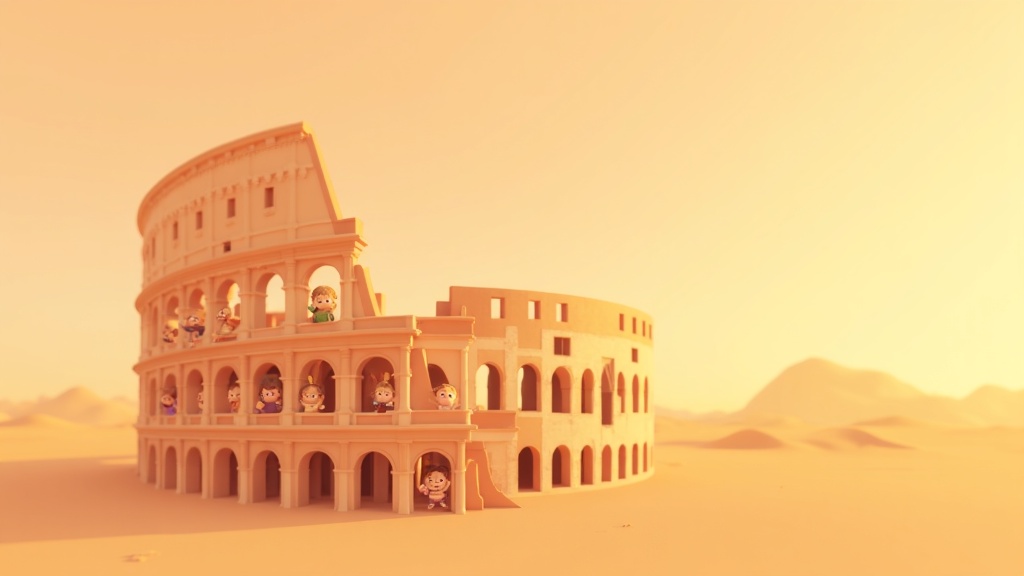
The Colosseum was a giant oval amphitheater in Ancient Rome, built almost 2,000 years ago to host public spectacles like gladiator fights. It was so massive it could seat 50,000 to 80,000 spectators, making it the ultimate entertainment venue of its time!
What if we told you there was a stadium so huge that it could fit almost every person in a small city inside it, all watching a show at the same time?!
Welcome, history explorers, to Ancient Rome! We’re talking about the Colosseum (also called the Flavian Amphitheater), one of the most famous buildings ever made. This giant, oval-shaped arena was built almost 2,000 years ago! It stands today as a massive symbol of the Roman Empire’s amazing building skills and its love for epic public shows. It’s one of the New 7 Wonders of the World!

Mira says:
"Imagine this: the first games held here lasted for **100 days**! That's way longer than any holiday break! It must have been the loudest, most exciting place on Earth for the Romans."
What is the Colosseum Anyway?
The Colosseum is a giant amphitheater. An amphitheater is just a fancy word for a huge, round or oval building with seats that go up in circles around a flat center stage. Think of the biggest sports stadium you've ever seen—the Colosseum was Rome’s version, but way older!
It was built to host amazing public spectacles, like gladiator fights, wild animal hunts, and even dramas based on Roman myths. The Romans absolutely loved these games as a way to be entertained and for the emperors to show how generous and powerful they were.
Mind-Blowing Fact!
The word 'arena' actually means 'sand' in Latin! That's because the wooden floor of the Colosseum was covered in a thick layer of sand to soak up the blood from the fights. Yikes!
How Big Was This Ancient Giant?
The Colosseum is truly massive! It was built using strong materials like stone and concrete. The outer wall, which is still partly standing, towered about 157 feet (48 meters) high! That’s as tall as a modern 12 to 15-story building!
It’s shaped like a huge oval, about 615 feet (189 meters) long and 510 feet (156 meters) wide. Getting everyone inside and out needed to be fast, so they built 80 entrances! Spectators had a ticket that told them which numbered entrance to use, kind of like finding your seat at the movies today.
People it could hold
For fast entry and exit
Started by Emperor Vespasian
During the opening games alone
How Did They Build the Colosseum?
Building something this enormous took serious teamwork and materials! The whole thing was put together in less than 10 years, which is super fast for something this big without modern machines.
Emperor Vespasian started the construction around 70-72 AD, and his son Titus finished it in 80 AD! The money to pay for it came from treasures taken after the Romans won the war in Jerusalem.
Materials and Workers
The Romans used super strong materials like travertine limestone, a volcanic rock called tuff, and Roman concrete. The huge stone blocks were sometimes held together without cement, using 300 tons of iron clamps!
Tens of thousands of laborers, including many Jewish prisoners of war, did the heavy work, while skilled Roman engineers, artists, and builders designed and created the detailed parts.
💡 Did You Know?
For special, super-fancy shows, the Romans could even flood the arena floor with water to stage mock sea battles! Imagine watching tiny ancient boats fight right where the gladiators usually stood!
🎯 Quick Quiz!
What was the original, official name for the Colosseum?
Who Sat Where in the Seats?
Seating in the Colosseum wasn't random; it showed exactly where you stood in Roman society! Everyone got a spot based on their job and status, all controlled by Roman law.
The very best seats, right by the action, were for the Emperor and the Vestal Virgins. Next came the Senators, followed by the noble class (equites). The regular Roman citizens sat higher up, and the poorest people sat in the very top gallery!
- Gladiator Fights (Munera): Battles between trained fighters, often to the death.
- Wild Animal Hunts (Venationes): Exotic animals like lions, bears, and tigers were brought in to fight each other or hunters.
- Public Executions: Sometimes criminals were made to fight or killed in dramatic ways as entertainment.
- Mock Naval Battles (Naumachiae): Brief periods when the floor was flooded for sea battle re-enactments!
Even after the big games stopped around the 5th century AD, the Colosseum didn't just vanish. Over time, it was used as a fortress, workshops, housing for poor people, and even a Christian shrine, showing how important it was to Rome for centuries!
Questions Kids Ask About Ancient Rome
Keep Exploring Roman History!
The Colosseum is an incredible reminder that history is full of huge, daring, and sometimes shocking stories. We hope you feel ready to explore more of the amazing world of Ancient Rome! Keep listening to History's Not Boring to discover more incredible tales from the past!