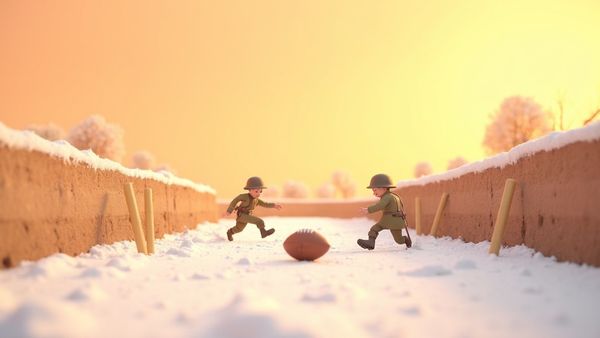
The Christmas Truce of 1914 was a series of unofficial ceasefires along the Western Front during World War I where opposing soldiers stopped fighting to share carols and gifts. Around 1914, soldiers even played football in No Man's Land, showing humanity during wartime. It’s a heartwarming moment in history for kids to learn about.
Imagine this: It’s Christmas Day, but instead of cozy fires, you’re freezing in a muddy hole in the ground called a trench. Then, you hear carols coming from the enemy’s side!?
This isn't a made-up story—it's the real, incredible tale of the Christmas Truce of [1914](/learn/christmas-truce-1914-for-kids) during World War I! For just a few magical days, the fighting on parts of the Western Front stopped. Soldiers who had been trying to defeat each other suddenly became neighbors, sharing food, singing songs, and yes, even playing a game of football right there in No Man's Land! It was a powerful moment where humanity shone through the darkness of war, proving that even enemies can find common ground, especially when the beautiful game is involved.

Mira says:
"Wow, Mira! Can you believe they stopped shooting just to play a game? It shows that even when people are on different sides, they still love things like family, holidays, and football, just like us!"
What Was the Christmas Truce of 1914?
World War I started in 1914, and by December, soldiers from countries like Britain, France, and Germany were dug into deep trenches, only separated by a dangerous strip of land called No Man's Land.
The first Christmas of the war was tough. But on Christmas Eve, something amazing happened. German soldiers lit candles on small Christmas trees and placed them on their trenches. Then, they started singing Christmas carols!
British soldiers answered back with their own songs. Soon, friendly shouts crossed the battlefield. Soldiers started climbing out of their trenches—carrying white flags or just their good cheer—to meet in the middle. This amazing, temporary peace was the Christmas Truce.
Mind-Blowing Fact!
The Christmas Truce was NOT official! Generals on both sides did NOT order it to happen. It was a decision made by the regular soldiers on the front line who were tired of fighting for just a little while.
How Did Football Become Part of the Peace?
When soldiers met in No Man's Land, they exchanged gifts like cigarettes, chocolate, and buttons. But some soldiers brought something special: a football! Football (soccer to some of you!) was super popular back then.
One famous story says that a British soldier brought out a football, and soon, a game started right there on the frozen, bumpy ground. Imagine trying to play a smooth game when the field is uneven and full of shell holes! It wasn't a fancy match, more like a giant, friendly kickabout with everyone joining in.
Historians aren't totally sure if one big, organized game happened everywhere, but many soldiers wrote letters home saying they had a 'football match' or a 'general kickabout' with the enemy. It was a way to be normal, even for a day.
where some form of truce happened
for the German victory (but this is debated!)
The Strange 'Football Match' Details
Some letters written by soldiers claimed a real match took place, sometimes even listing a score! One famous, though disputed, account mentioned the Saxons (Germans) beating the English 3-2.
Since they didn't have proper goalposts, soldiers used things like their great coats to mark where the nets should be! It was chaotic, fun, and totally against the rules of war.
What Did They Kick?
If a real leather football wasn't available (which was likely!), one soldier even wrote about kicking a bully beef tin around!
Imagine that! A tin of preserved meat becoming the star of a World War I 'international' match. It shows how creative soldiers were just to have a little fun and forget the fighting.
💡 Did You Know?
The aftermath of the truce was interesting! After Boxing Day (December 26th), the generals on both sides were very unhappy that their soldiers had been friendly. They made sure the massive truce didn't happen again the next year.
🎯 Quick Quiz!
What was the strip of land between the trenches called where the soldiers met?
Why Do We Still Talk About This Today?
The Christmas Truce is famous because it shows a glimmer of hope. Even when people are told to hate each other, they sometimes choose kindness instead.
It reminds us that soldiers are just people—sons, brothers, and friends—who were put into a terrible situation. The football game, whether it was a real match or just a quick kickabout, became a symbol of that shared human spirit.
It’s a great story to learn for kids because it teaches us that friendship and peace are stronger than fighting.
- Exchanging Gifts: Soldiers traded food, tobacco, and souvenirs like buttons and badges.
- Burying the Dead: In some areas, the truce was used to respectfully bury soldiers who had died the day before.
- Singing Together: Groups of British and German men sang carols side-by-side in the open.
- Making Promises: Some soldiers agreed not to shoot until a certain time the next morning.
Though the truce of 1914 was mostly over by December 27th, and later years of the war were much grimmer, the memory of those soldiers playing football remains one of the most heartwarming, hopeful stories from all of history for kids to discover!
Questions Kids Ask About World War I
Keep the Spirit Alive!
Isn't that an amazing story? The next time you play football with your friends, remember those soldiers who found a way to put down their weapons for a game. History isn't always about big battles; sometimes it's about small, brave acts of friendship! Keep listening to History's Not Boring for more awesome true stories!