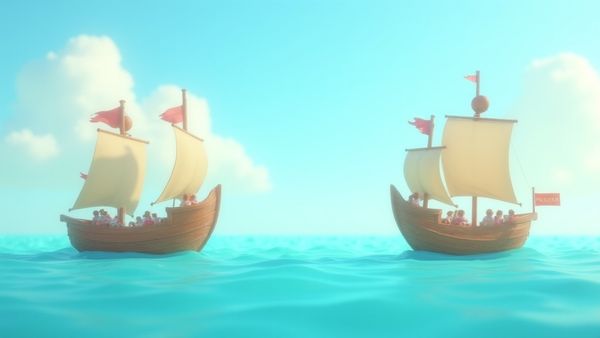
The Spanish Armada was a massive fleet of over 130 ships sent by King Philip II of Spain to invade Protestant England in 1588. Despite being the world's superpower, their 'Invincible' fleet was famously defeated by Queen Elizabeth I’s smaller, faster English Navy. This battle changed British history forever.
What if one country tried to send over 130 massive ships to invade an island, but a much smaller navy stopped them? It sounds like a movie, but it really happened in history!
This epic sea showdown was the fight against the Spanish Armada in the summer of 1588! King Philip II of Spain had a HUGE fleet he called the 'Invincible Armada'—meaning it couldn't be beaten! His goal was to sail up the English Channel, join his army waiting in the Netherlands, and bring England back to the Catholic Church. The English Queen, Elizabeth I, and her daring sailors, like Sir Francis Drake, were ready to defend their country! This battle changed the course of British history forever.

Mira says:
"Wow, 130 giant ships! That’s like a floating city trying to attack. I can’t wait to hear how the smaller English ships outsmarted them!"
What Was the Spanish Armada, Anyway?
Imagine a fleet of ships so big it was meant to be unstoppable—that was the Spanish Armada. Spain was the biggest superpower of the time, and King Philip II was determined to conquer Protestant England.
The plan was for the Armada to sail up the English Channel, link up with his waiting army in the nearby Spanish Netherlands (modern-day Belgium/Netherlands), and then ferry thousands of soldiers across to invade England.
The Spanish believed their massive ships, packed with soldiers ready to fight hand-to-hand, were the best way to win a sea battle.
Mind-Blowing Fact!
The English sailors, led by Lord Howard and Sir Francis Drake, knew they couldn't win a close-quarters fight, so they practiced a totally new way of fighting: shooting cannons from far away!
Who Was Fighting and How Big Were Their Fleets?
It wasn't just Spain against England; it was a huge clash of two powerful navies! The size of the fleets is wild to think about, even for grown-ups!
While the English had fewer real warships, they were faster and better at using their cannons. They were ready to fight a modern sea battle for kids to learn about!
(Sailed from Lisbon)
(Ready to invade)
(The main warships)
(Queen Elizabeth I's reign)
How Did the English Outsmart the Giant Armada?
The English knew their ships, called galleons, were lower, faster, and had much better cannons than the tall, clunky Spanish ships. Their strategy was all about speed and distance.
Step 1: The Chase Up the Channel
When the Armada sailed into the English Channel in late July 1588, the smaller English fleet harassed them constantly. They zoomed in, fired their long-range cannons, and sped away before the Spanish could get close enough to board their ships!
Step 2: The Fire Ship Surprise!
The Spanish anchored near Calais, waiting for their army. This was the moment the English needed! They sent eight old ships packed with flammable stuff straight into the Spanish fleet at midnight, setting them on fire! This terrifying sight made the Spanish panic.
Step 3: The Battle of Gravelines
The fire ships scattered the Armada's famous crescent shape. The next day, at the Battle of Gravelines, the English could close in. They hammered the Spanish ships with cannon fire, doing serious damage while the Spanish struggled to reload and fight back effectively.
💡 Did You Know?
The Spanish plan never worked because the army leader, the Duke of Parma, couldn't get his troops ready in time to meet the Armada at Calais! The English victory was sealed before the worst fighting even started.
🎯 Quick Quiz!
What did the English use to panic the anchored Spanish fleet near Calais?
Why Did the Armada Finally Fail?
After being scattered and battered, the Duke of Medina Sidonia realized the invasion was impossible. The wind changed, blowing the Spanish ships north, forcing them to sail all the way around Scotland and Ireland to get home to Spain. This long journey was even deadlier than the fighting!
- The terrible weather and storms wrecked many Spanish ships off the coasts of Ireland and Scotland.
- The English ships were faster and more maneuverable (easier to turn).
- The English used long-range cannons better, keeping a safe distance.
- The Spanish soldiers were trained for boarding enemy ships, not long cannon fights.
Only about 60 of the original 130+ ships limped back to Spain. The defeat of the Spanish Armada was a huge moment! It proved England was a major sea power and saved Queen Elizabeth I’s throne, securing the Protestant faith in the country.
Questions Kids Ask About British History
Keep Exploring the Seas of History!
The story of the Spanish Armada shows that being bigger doesn't always mean you win! Clever tactics and brave sailors—like the English had—can absolutely change the world. Keep listening to History's Not Boring to find out about more amazing battles and brilliant ideas!