
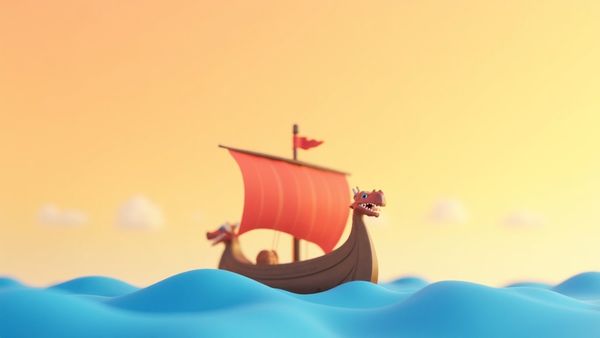
Viking longships were fast, flexible warships built mainly from oak wood during the Viking Age (c. 790–1066 AD). They used the 'clinker method,' overlapping planks like shingles, which made them sturdy yet speedy enough for lightning raids across Europe. Up to 60 oarsmen propelled these amazing vessels!
Have you ever heard of warriors who sailed across massive oceans in ships so fast they seemed to appear out of nowhere?
These were the Vikings, fierce people from Scandinavia who sailed their amazing boats all over Europe during the Viking Age, which lasted from about the late 700s until 1066! While they were also traders and explorers, they became famous (and sometimes feared!) for their lightning-fast raids on faraway coasts. The secret to their adventures wasn't just bravery—it was their incredible, world-changing technology: the Viking longship!

Mira says:
"I can’t believe how many ships they could fit on one beach! Their longships were like the perfect, speedy getaway cars of the Middle Ages!"
What is a Viking Longship?
Imagine a boat built almost entirely out of oak wood. That was the longship! These ships were not only long and narrow—perfect for speed—but they also had a super clever design that made them tough for rough seas and fast for surprise attacks.
Viking shipbuilders were masters! They used something called the 'clinker method,' where they overlapped the oak planks like roof shingles and nailed them together with iron rivets. To make sure these awesome boats didn't leak, they stuffed the gaps between the planks with wool or animal hair and sealed it all with sticky tar.
Mind-Blowing Fact!
Viking ships had flat bottoms! This meant they could sail in very shallow water, sometimes just a meter deep, and land right on the beach. This made it easy to launch a surprise raid and then quickly pull the boat out of the water to escape!
Speed Stats: How Fast Could These Ships Go?
The longships were built for speed and flexibility. They used both a big, square wool sail and rows of oars, which meant they weren't stuck if the wind stopped blowing!
For their warships, called *drakkars* (dragon ships), speed was everything. They were long and narrow with lots of oarsmen ready to paddle hard for a quick attack or escape.
(45 to 75 feet)
On the largest warships
(Under ideal weather)
How Did the Vikings Navigate the Open Ocean?
Sailing hundreds of miles across the gray, cold ocean takes serious skill! Vikings didn't have GPS or maps like we do today. They relied on their sharp eyes and deep knowledge of the sea.
Tools of the Viking Navigator
They used the sun and the stars to find direction, especially when sailing toward the unknown lands like Iceland or Greenland.
They also paid close attention to nature! They watched the behavior of birds, where fish were swimming, and how the tides and currents were moving to figure out where they were going.
For tricky cloudy days, some ships likely used a special crystal called a sunstone to help locate the sun's position, even through the clouds!
💡 Did You Know?
Viking ships were so important that when a powerful chief died, his magnificent longship was sometimes buried with him as a final resting place, often covered with earth to create a massive burial mound!
🎯 Quick Quiz!
What was the main reason Viking longships had a flat bottom?
Why Did the Raids Begin and Where Did They Go?
The Viking Age truly kicked off with a famous event in 793 AD when Vikings made a shocking raid on the Lindisfarne Monastery in England. This was a huge shock to Christian Europe because it was a sudden, large-scale attack on a peaceful holy site.
- Early Raids (Late 700s): Swift, hit-and-run attacks, often targeting wealthy, undefended monasteries, like the one at Lindisfarne.
- Invasions (Mid-800s): The raids became bigger and more organized. The Great Heathen Army landed in England in 865 AD, showing they wanted to conquer and settle, not just loot!
- Major Targets: Vikings attacked places all over! They sailed to Ireland (where they founded Dublin in 840 AD), sacked cities like Paris in 845 AD (demanding a huge ransom!), and even reached as far as Constantinople (modern-day Istanbul).
The Viking Age of raiding finally slowed down after 1066, especially after the Norwegian King Harald Hardrada was defeated in England at the Battle of Stamford Bridge. While the ships didn't disappear, the era of widespread, unstoppable Viking raids was over as Europe got better at defending itself!
Questions Kids Ask About Medieval History
Keep Sailing Through History!
From the speed of their oak hulls to the bravery of their crews navigating by the stars, Viking ships were true marvels of engineering! They truly opened up the world for the people of Scandinavia. What other amazing inventions do you think changed history for kids?