
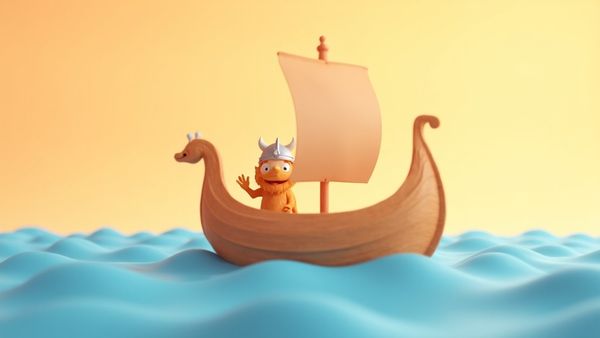
The Viking Age was a period from the late 700s to the mid-1000s AD when explorers from Scandinavia sailed and traded across the world. They reached North America almost 500 years before Columbus! Learn how their shallow-draft longships made these amazing journeys possible.
Have you ever heard of explorers who sailed the wildest seas in dragon-headed ships, traveling farther than almost anyone else in their time?
Get ready to learn about the Vikings! These fierce, fascinating people came from Scandinavia (modern-day Norway, Sweden, and Denmark) during a time called the Viking Age, which lasted from about the late 700s AD to the mid-1000s AD. While you might think of them only as warriors, Vikings were also amazing sailors, traders, and adventurers who explored huge parts of the world! They sailed across the ocean to trade furs and amber and even reached the shores of North America almost 500 years before Columbus!

Mira says:
"Wow, Finn! I can't believe they sailed all the way to North America! Their ships must have been super strong to handle the huge ocean waves. It's so cool how they were explorers AND traders!"
What Are Viking Longships and Why Were They So Special?
The most famous Viking invention is the longship! These boats were designed for speed and adventure. Unlike many other ships, longships had a very shallow draft, which means they didn't sit deep in the water.
This special design let them do two amazing things: they could cross the rough, deep ocean, AND they could easily sail up shallow rivers deep into a country where no one expected them!
A big Viking warship could have a crew of up to 100 warriors! They could use big square sails when the wind was blowing, or they could use dozens of oars when they needed to go faster or the wind wasn't helping.
Their top speed under the right wind conditions could be as high as 15 knots! That's really fast for a wooden ship hundreds of years ago.
Mind-Blowing Fact!
Some of the largest Viking ships discovered, like the Roskilde 6, were nearly 36 meters (118 feet) long—that’s longer than a full-size school bus!
How Far Did the Vikings Travel? Amazing Distances!
The Vikings were masters of navigation. They used the stars, the sun, and even the birds to find their way across vast oceans.
Their travels created an incredible network of routes that stretched from the cold North Atlantic to the warm Middle East!
The Vikings didn't just stick to one area. They set up trade centers and settlements in places like Ireland (founding Dublin!), France (where they became known as the Normans), and even Russia where they were called the Varangians.
The main span of the Viking Age
Leif Erikson reaches North America
Common on a large war longship
Erik the Red set out with this many to settle Greenland
How Did Vikings Trade Goods Across the World?
Vikings were smart business people! While raids brought in quick treasure, building trade routes brought in steady wealth.
They were the economic middleman, connecting different parts of the world.
They traded things found in the North, like furs, amber (fossilized tree sap used for jewelry), and walrus ivory, for amazing luxury items from the South.
From East to West: Viking Commerce
The Vikings sailed east, using rivers like the Volga and Dnieper, to reach the mighty Byzantine Empire (Constantinople) and the Islamic world.
In return for their northern goods, they brought back silver coins from the Middle East, plus silks, spices, and wine—things that were super rare in Scandinavia!
💡 Did You Know?
The slave trade was also a big, though very dark, part of the Viking economy. Captives from raids were sold in major trading centers like Dublin, which became the biggest slave port in Western Europe at that time.
🎯 Quick Quiz!
What did Leif Erikson famously name the part of North America he explored?
Who Were the Famous Viking Explorers?
The Viking Age is filled with legendary names! The biggest explorers sailed west, settling new lands across the North Atlantic.
The journey started with the settlement of Iceland in the late 800s.
- Erik the Red: After being exiled from Iceland for a fight, he sailed west and discovered and settled Greenland around 985 AD!
- Leif Erikson: The super-famous son of Erik the Red! Around the year 1000 AD, he sailed even farther west and became the first known European to set foot on the continent of North America, which he called Vinland.
- Bjarni Herjolfsson: Legend says he was the first Viking to accidentally *see* North America when he got blown off course while sailing to Greenland a few years before Leif Erikson’s famous journey!
Even after the Viking Age officially ended around 1066 AD (with the Battle of Stamford Bridge in England!), the spirit of adventure lived on. The Vikings weren't just raiders; they were brave pioneers who shaped maps, created trade routes that lasted for centuries, and showed the world just how powerful a well-built ship could be!
Questions Kids Ask About Medieval History
Keep Exploring the Seas of History!
From their incredible, fast longships to charting courses across the vast Atlantic, the Vikings were true pioneers of the Medieval world. What other incredible explorers from history will you discover next? Keep listening and learning!