
When Sarah was born, her parents opened a custodial account and invested £50 a month in an index fund. By the time she turned 18, those monthly contributions had grown to over £15,000.
A custodial account is a special type of financial account that an adult manages for a minor. It allows you to build an investment portfolio for your child before they are legally allowed to sign contracts or open their own brokerage accounts.
The account was legally hers: she used it to help pay for university. This is the power of starting early. But before you open one, you need to understand how they work, who really owns the money, and the big responsibility that comes when your child grows up.
The Power of Starting at Birth: If you invest $100 a month at a 7% annual return: - After 5 years: $7,100 - After 10 years: $17,300 - After 18 years: $41,500 Your total contribution: $21,600. The growth: $19,900.
What is a Custodial Account?
Think of a custodial account as a bridge. Children under 18 or 21 (depending on where you live) cannot legally own stocks or bonds directly. A custodial account allows you to hold these assets in their name while you make the decisions.
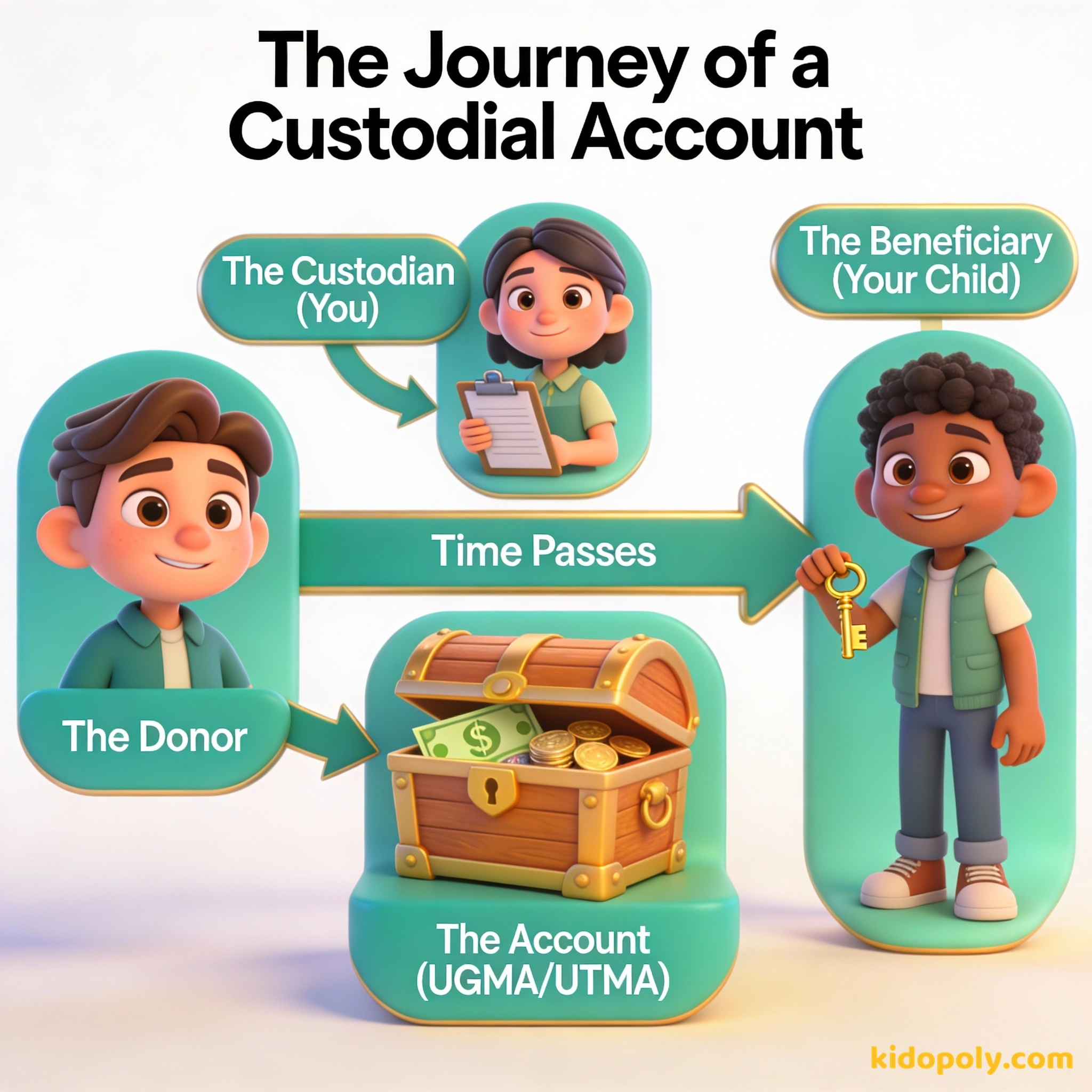
You act as the custodian, which means you manage the money, choose the investments, and decide when to sell. However, the child is the beneficiary. This means the money legally belongs to them from the very first moment you deposit it.

Finn says:
"Wait, so if I'm the owner, why can't I buy 5,000 gummy bears right now? Who decided my parents get to hold the remote?"

Someone is sitting in the shade today because someone planted a tree a long time ago.
UGMA vs UTMA: What’s the Difference?
When you open an account at a brokerage like Fidelity or Schwab, you will likely see two acronyms: UGMA and UTMA. They stand for the Uniform Gifts to Minors Act and the Uniform Transfers to Minors Act. While they sound similar, they cover different types of gifts.
- UGMA accounts are limited to financial assets. This includes cash, stocks, bonds, and mutual funds.
- UTMA accounts are more flexible. They allow for financial assets plus physical property like real estate or fine art.

In most states, the 'Age of Majority' is 18, but for UTMA accounts specifically, many states have raised the age of transfer to 21 or even 25. This gives the money more time to grow and the child more time to mature.
Most modern families choose the UTMA because of that extra flexibility. However, if you are just planning to invest in the stock market, both work effectively. Check with your state laws, as some states only recognize UGMA while others allow UTMA until age 21 or even 25.
The Golden Rule: The Irrevocable Gift
This is the most important part of the entire guide. Any money you put into a custodial account is an irrevocable gift. This is a fancy way of saying you can never take the money back for yourself.
If you have a financial emergency next year, you cannot dip into the custodial account to pay your mortgage. The money belongs to your child. You can only withdraw funds if they are used for the direct benefit of the child, such as summer camp or a laptop for school.

Mira says:
"It's like a birthday present that you aren't allowed to unwrap for ten years. It's yours, but it's staying on the high shelf for safekeeping."
Very safe but earns almost zero interest. The money loses value over time because of inflation.
Can lose value in the short term, but historically grows much faster. Ideal for 10+ year timelines.
The Big Catch: Control at 18 or 21
Parents often love the idea of saving for their kids, but they worry about what happens when the child grows up. In a custodial account, the child gets full control the moment they reach the age of majority. In most states, this is 18 or 21.
At that exact moment, they can do whatever they want with the money. They could use it for a down payment on a house, or they could spend it all on a luxury holiday. As the parent, you no longer have any legal say in how the money is spent.

The best way to teach your kids about taxes is by eating 30 percent of their ice cream.
This is why it is so important to combine a custodial account with financial education. If you spend 18 years building the account but zero years teaching your child how to manage money, the hand-over could be stressful. You are handing them the keys to a car: make sure they know how to drive first.

Imagine your child at 21. They are finishing university and want to start a business or travel the world. Instead of starting from zero, they have a 'launch pad' of funds that you spent their whole childhood building. It's a massive head start in life.
Simplified Tax Rules: The Kiddie Tax
Custodial accounts offer some tax advantages, but they are not completely tax-free. Because the account is in the child’s name, the first portion of the investment gains is usually tax-exempt. After that, the next portion is taxed at the child’s (usually lower) tax rate.
However, if the account earns a lot of money, the Kiddie Tax kicks in. This means any earnings above a certain limit (currently around $2,600 per year) are taxed at the parents' higher tax rate. This prevents wealthy families from hiding all their income in their children's names.
Finn says:
"So if the money grows a lot, I have to give some to the government? Even if I'm only ten years old?"
How to Open a Custodial Account
Opening an account is surprisingly simple and usually takes less than ten minutes. Most major online brokerages offer them with no minimum balance required to get started. You will need your child’s Social Security number and your own identification.
- Choose a brokerage that fits your needs.
- Select 'Custodial Account' (UGMA/UTMA) during the setup.
- Link your bank account to transfer funds.
- Choose your investments (like index funds or ETFs).

An investment in knowledge pays the best interest.
Sit down with your child and look up a 'Compound Interest Calculator' online. Let them pick a monthly amount (like the cost of a video game) and see how much it could become by the time they are 20 years old. Visualizing the numbers makes it real.
If you want to explore other ways to save, you can check out our guide on investing-accounts-for-kids. If your child has a part-time job, a roth-ira-for-kids might be an even better tax-saving option.
Something to Think About
If you could give your 18-year-old self a lump sum of money, what lesson would you have wanted to learn first?
This is about your personal family values. There is no right answer, but it can help you decide how much to invest and how to talk to your child about it as they grow.
Questions About Investing
Can I use the money for my own expenses if I'm in a pinch?
How do custodial accounts affect financial aid for college?
What happens if the child doesn't want the money at 18?
Ready to Start Building?
Custodial accounts are one of the simplest ways to give your child a financial advantage. By starting today, you are giving them the gift of time. Your next step is to choose a brokerage and decide on a small, monthly amount that fits your family's budget.