
Can a four-year-old really understand what a chocolate bar costs, or should you wait until they are older to talk about price tags?
Teaching your child about money is not a one-time conversation, it is a gradual process that follows their developmental stages. By matching financial literacy concepts to what their brains are ready to handle, you can turn everyday moments into powerful lessons about economics and personal finance.
A 4-year-old can learn that a chocolate bar costs money. A 7-year-old can save pocket money for three weeks to buy a toy. A 12-year-old can manage a monthly budget. A 16-year-old can invest in a stocks and shares ISA.
Research suggests that you have a narrower window than you might think to set the foundation. A landmark study from the University of Cambridge found that basic money habits are typically formed by age 7. This means the way your child views spending, saving, and delayed gratification is often rooted before they even leave primary school.

A study by Cambridge University researchers found that children's money habits are formed by age 7. This includes the ability to plan ahead and the understanding that some choices are irreversible.
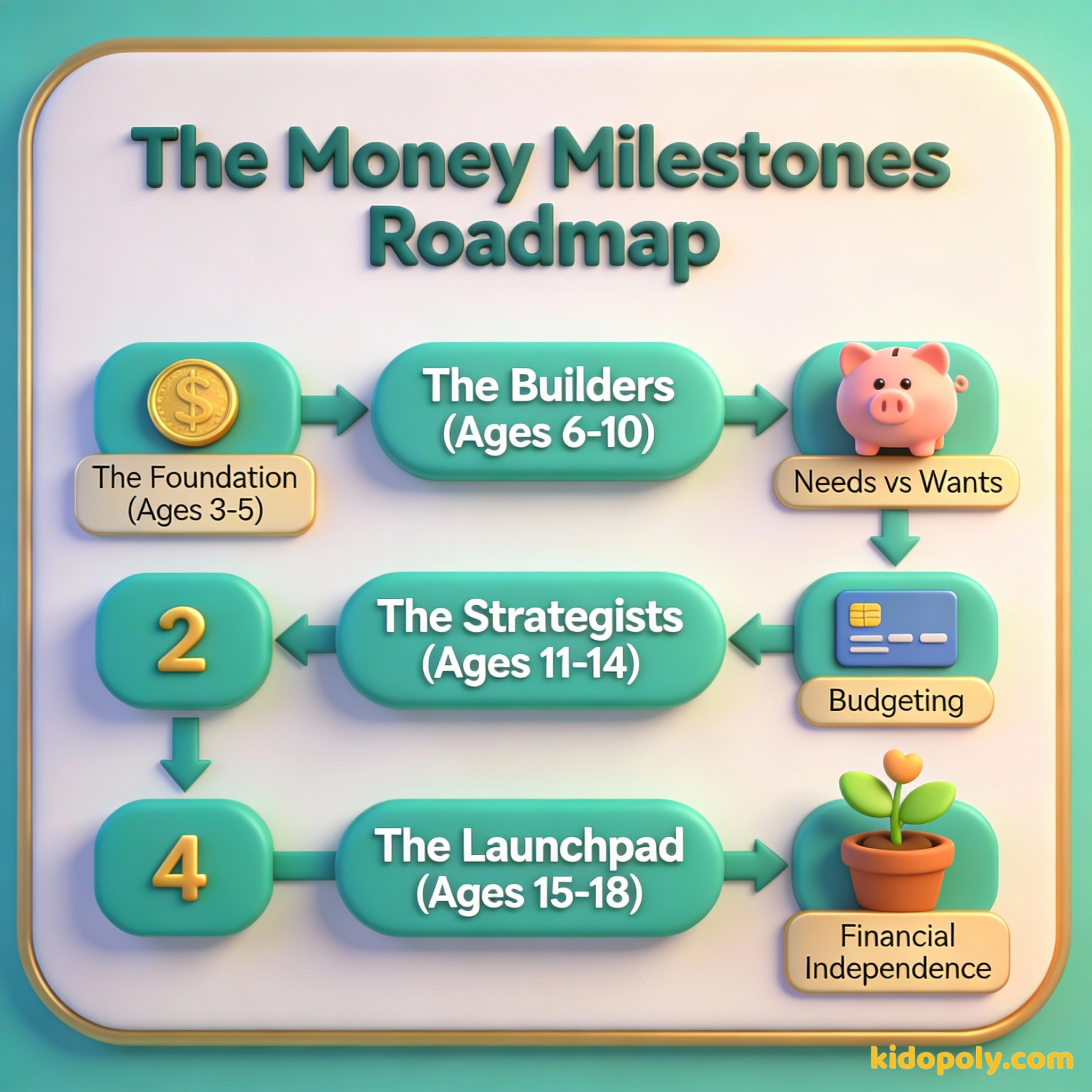
Ages 3 to 5: The Foundation
At this stage, children are learning that money is a tool used to get things. They are moving from thinking money is 'magic' to understanding it is a finite resource. Focus on coin recognition and the basic concept of counting.
Help them identify different denominations and explain that we trade these items for goods at the store. You can practice simple choices by letting them pick between two small items at the shop, explaining that we often have enough for one, but not both.

Mira says:
"I remember thinking the bank just gave people money for free because of the 'magic' ATM. Seeing my parents count physical coins helped me realize it actually comes from somewhere!"

Do not save what is left after spending, but spend what is left after saving.
Ages 6 to 8: The Builders
By age 6, most children are ready to understand the concept of earning money. This is the perfect time to introduce the difference between needs vs wants. A need is something essential like food or a coat: a want is something fun like a new sticker book.
This is also when short-term goals become achievable. If they want a specific toy, help them track how many weeks of saving it will take to reach that price. This builds the 'waiting muscle' that is essential for financial health later in life.
The 'Three Jars' Method: For kids aged 6-10, use three clear jars labeled Spend, Save, and Give. When they receive money, help them divide it. This makes the abstract concept of 'budgeting' visible and physical.
Ages 9 to 11: The Strategists
As kids head toward middle school, they can handle more complex budgeting basics. Instead of just saving for one toy, they can start to manage a small amount of money for multiple purposes. This is an excellent age to open their first bank account.
You can also introduce comparison shopping. Show them two brands of the same cereal and look at the price per gram. They will begin to see how being a 'smart shopper' leaves them with more money for other things they value.

Finn says:
"Wait, if I put my money in a bank account, they actually pay me just for keeping it there? That sounds like the easiest way to earn money ever."

An investment in knowledge pays the best interest.
Ages 12 to 14: The Operators
Teenagers are ready for more independence. At this stage, they should be budgeting independently for their own social outings or hobbies. This is also the time to explain interest, both the kind you earn in a savings account and the kind you pay on a loan.
The Power of Interest: If a 14-year-old saves $100 and earns 5% interest per year: Year 1: $105.00 Year 5: $127.63 Year 10: $162.89 Without doing any extra work, their money grew by 62% just by waiting!
They should also begin to understand the mechanics of credit and debt. Explain that using a credit card is borrowing money that must be paid back, usually with extra costs. If they are old enough for a part-time job or a neighborhood paper round, they can experience the direct link between effort and income.
Ages 15 to 17: The Launchpad
As adulthood approaches, the focus shifts to financial independence. Your teen should be handling real banking, perhaps with a debit card and a mobile banking app. They need to understand taxes and how a 'gross salary' is different from 'take-home pay'.
Mira says:
"Looking at a real payslip was a shock. I didn't realize how much goes toward taxes before you even see the money in your account!"
Introduce investing concepts, such as how the stock market works and why people invest for the long term. If your region allows, look into a junior ISA or similar tax-advantaged accounts. This is their final training ground before they manage their own finances entirely.

Imagine your 17-year-old getting their first full-time paycheck. Instead of spending it all in 48 hours, they already have a plan to move 20% to savings, pay their phone bill, and keep the rest for fun. That is the power of starting early.

Financial peace isn't the acquisition of stuff. It's learning to live on less than you make.
It is Never Too Late
If your child is already 14 and you have not talked about money, do not panic. Every age has its own starting point. The goal is not perfection, but providing a framework so they can make informed decisions.
Start wherever you are today. If you need more general tips on how to begin these conversations, you can explore our guide on how to teach kids about money. If you are wondering when to start an allowance, check our guide on when to start pocket money.
Something to Think About
What is the one money habit you wish you had learned by age 10?
There are no wrong answers here. Thinking about your own financial journey can help you decide which lessons are most important to pass on to your child.
Questions About Learning & Teaching Money
Am I starting too late if my child is already a teenager?
When is a child old enough to understand saving?
Should I link chores to money?
Your Next Step
Now that you have the roadmap, pick one age-appropriate activity to try this week. Whether it is sorting coins with a toddler or looking at a savings account with a pre-teen, the best way to teach is through doing. For more structured learning, visit our section on financial literacy for elementary students.
