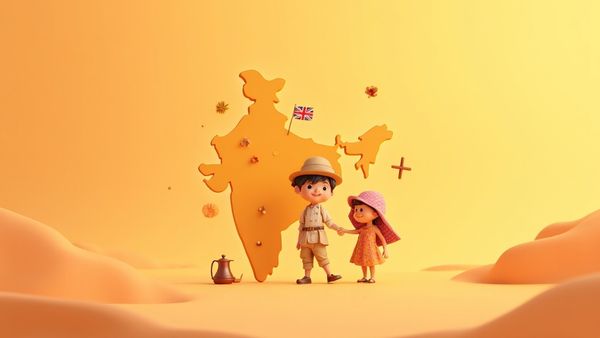
The British Empire in India, known as the British Raj, was the period when Great Britain directly ruled the Indian subcontinent. This crucial rule lasted from 1858 to 1947. Discover the spices, rulers, and massive changes that shaped this history!
Have you ever heard of a time when one country ruled over a giant land filled with spices, beautiful fabrics, and millions of people, all from very far away?
That’s the incredible story of the British Empire in India, also known as the British Raj! 'Raj' is a Hindi word that means 'rule' or 'government.' This huge period of time lasted from 1858 to 1947. India was so important to Great Britain that it was often called the “Jewel in the Crown” of the entire Empire because of its wealth and resources! It’s a history filled with trade, massive changes, and the brave fight for freedom that we need to learn about for kids.
Mira says:
"Wow, an empire that covered so much ground! It’s like Great Britain had a giant piece of the world map colored in for itself. I wonder how they managed to control such a huge place!"
What Was the British Raj?
Before it was the British Raj, powerful trading businesses from Britain started showing up in India, most famously the East India Company. This company had its own army and slowly gained more and more control over different areas, mostly by trading things like spices, silk, and cotton.
But things got really rocky around 1857 with a big event called the Indian Rebellion of 1857. After this, the British government decided that the trading company couldn't handle it anymore. So, in 1858, the British Crown—the King or Queen—took direct control! This new period of direct rule is what we call the British Raj.
Mind-Blowing Fact!
The British Raj didn't just rule over modern-day India! It included areas that are now part of Pakistan, Bangladesh, Sri Lanka (then called Ceylon), and Myanmar (then called Burma)! That’s a lot of land!
The 'Jewel in the Crown' and Amazing Numbers
Why was India considered the most valuable part of the whole British Empire? Think of it like this: India had tons of valuable things that Britain needed for its factories and for its people to buy.
Britain wanted the resources! They took huge amounts of cotton for their clothing factories and valuable spices like pepper—which was like black gold back then! They also used the huge population of India as a source of cheap labor and a big market to sell their own finished goods.
After the Indian Rebellion of 1857
India and Pakistan gained independence
From 1858 to 1947
By 1909, it was massive!
How Did the British Build So Much in India?
Even though the British took wealth from India, they also built a lot of new things—mostly to help them move goods and keep control. Think of it like building super-fast roads just so you can deliver your homework faster!
The biggest change was the railroads. The British built an enormous railway network across the subcontinent.
Building the Rails
The first railways started even before the Raj, in 1853, but they grew super fast under Crown rule. By 1909, the Indian railway system was the fourth largest in the entire world! This helped them move raw materials like cotton to the ports to ship back to England.
💡 Did You Know?
One of the most famous buildings from this time is Victoria Terminus in Mumbai (now called Chhatrapati Shivaji Maharaj Terminus), which was completed in 1888. It was called 'The most magnificent railway station in the world'!
🎯 Quick Quiz!
What word means 'rule' or 'government' in Hindi, which is part of the name 'British Raj'?
Who Was in Charge and How Did It End?
Under the Raj, some areas were ruled directly by a British person called the Governor-General, who was also the Viceroy—basically the King or Queen's stand-in.
In 1876, Queen Victoria took an extra special title: Empress of India! This showed everyone how important India was to her.
- Princely States: Hundreds of smaller kingdoms in India still had their own local rulers, but they had to follow the main orders from the British.
- British India: These were the areas ruled directly by the British Governor-General.
- The End: After World War II, Britain was tired and realized it couldn't hold onto India forever. Indian leaders, like Mahatma Gandhi with his peaceful protests, worked hard for independence.
- Independence and Partition: On August 15, 1947, British rule ended! But sadly, the land was divided into two new countries: India and Pakistan. This event is called the Partition of India and caused huge, sad movements of people.
The story of the British Empire in India is a long one, filled with spices, huge railways, powerful rulers, and a massive, difficult change at the end. Learning about the British Raj helps us understand the history of modern India, Pakistan, and Bangladesh today!
Questions Kids Ask About World History
Keep Exploring the World's Story!
You just learned about one of the biggest chapters in world history! The British Empire in India changed the map, the economy, and the lives of millions. Keep digging into history to find more amazing stories of power, change, and people fighting for what they believe in!