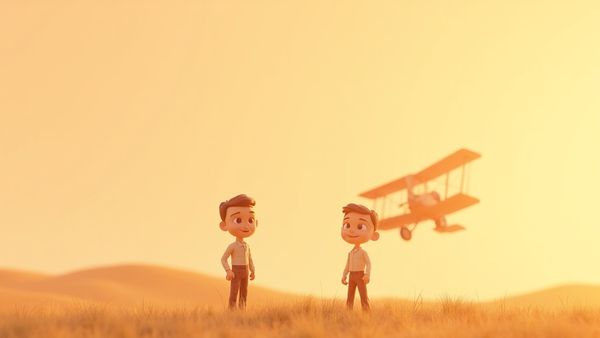
The Wright Brothers learned to fly by studying birds and solving the steering problem that baffled earlier inventors. Their breakthrough, 'wing-warping,' allowed them to control the wings like a bird twists them. This key innovation led to the first successful flight on December 17, 1903!
What if you wanted to fly, but everyone said it was impossible? That's exactly what happened to two determined brothers from Ohio!
Orville and Wilbur Wright—the Wright Brothers—are famous for inventing the airplane! But they didn't just wake up one day and magically build something that could soar. Their amazing success on December 17, 1903, at Kitty Hawk, North Carolina, was the result of years of clever thinking, lots of practice, and never giving up. They weren't trained scientists or millionaires; they were bicycle mechanics who loved solving puzzles. Their journey to learning how to fly for kids like you is an incredible story of the scientific method in action!

Finn says:
"Whoa! So they didn't just focus on making a big engine? They focused on *control*? That’s like learning to ride a bike before trying to drive a race car! Smart thinking, Wilbur and Orville!"
What Sparked Their Dream of Flying?
The dream to fly didn't start with an airplane at all—it started with a toy! In 1878, when Orville and Wilbur were just kids, their father brought home a small toy helicopter. It was made of paper, bamboo, and cork and was powered by a twisted rubber band.
When the toy finally broke, the brothers did what they always did: they built their own! This little toy showed them that air could lift something. They spent hours making their own versions fly higher and longer. This early tinkering taught them basic ideas about how air works—a super important first step!
Mind-Blowing Fact!
The Wright brothers didn't go to college! Instead, they opened a shop in Dayton, Ohio, where they fixed and built bicycles. Their experience with the chains, sprockets, and balance of a bicycle actually helped them figure out how to balance an airplane!
The Most Important Part: Learning to Steer!
Many inventors before the Wright brothers had built machines that could glide or even jump into the air for a moment. The biggest problem was that once they took off, they couldn't steer them properly and would crash.
The brothers studied birds closely. They noticed how birds tilted or twisted their wings to turn and stay balanced. They decided the airplane needed to do the same thing! This important idea was called wing-warping.
They turned their bicycle shop knowledge into airplane control! They used a system of cables and pulleys connected to a cradle that the pilot moved with their hips. Moving their hips twisted the wings slightly, giving them control over the plane’s roll, just like dipping a bike’s handlebars makes it lean.
Flew a 5-foot biplane kite to test wing-warping.
Made hundreds of glider tests at Kitty Hawk, NC.
Tested in their homemade wind tunnel to find the best wing design.
The distance of the first powered flight on December 17, 1903.
How Did They Know Which Wing Shape to Use?
After practicing with their first gliders in 1900 and 1901, the results weren't what they expected. The accepted science data they were using, mostly from a scientist named Otto Lilienthal, seemed to be wrong!
Instead of guessing, they used the scientific method. They built a small homemade wind tunnel in their bicycle shop. This was a game-changer!
The Wind Tunnel Breakthrough
The brothers didn't just look at old science; they made their own! They tested nearly 200 different miniature wing shapes inside their wind tunnel, gathering exact data on lift (how much the air pushes up) and drag (how much the air slows them down).
This testing allowed them to choose the most efficient wing design for their final plane. They also fixed the problem of the wobbly rudder on their 1902 glider, making it fully steerable—a huge success!
💡 Did You Know?
The Wright brothers chose Kitty Hawk, North Carolina, for their tests because it had soft sand for safe landings, tall sand dunes to help launch the gliders, and, most importantly, steady, strong winds!
🎯 Quick Quiz!
What was the MOST important problem the Wright Brothers were trying to solve before they added an engine?
The Final Piece: Making it Light and Powerful
Once they had the perfect wings from the wind tunnel, they knew they needed a motor that was powerful enough but super light. No such engine existed, so they designed and built their own!
Their friend Charles Taylor helped build the engine block out of aluminum—a strong, light metal. They also designed their own propellers to work perfectly with the engine and the new wing shape.
- Gliding Practice: They flew gliders (unpowered planes) from 1900 to 1902 to master control.
- Wind Tunnel Science: They tested 200 wing designs to gather brand new, accurate data for lift and drag.
- The Control System: They invented wing-warping, a movable rudder, and a forward elevator for the three-axis control needed for true flight.
- Custom Power: They built their own lightweight engine when they couldn't buy one that worked.
On that chilly morning of December 17, 1903, Orville won the coin toss to fly first! His first flight lasted only 12 seconds and covered just 120 feet—that's shorter than the wingspan of a giant jumbo jet today! But it proved their learning worked: they had achieved the world's first controlled, sustained, powered flight. The world of travel was changed forever because two determined brothers knew how to learn from every single attempt!
Questions Kids Ask About Inventions
Keep Reaching for the Sky!
The story of how the Wright brothers learned to fly is the ultimate example of curiosity turning into history. They failed many times with their gliders, but they never stopped testing, observing, and improving. That's the secret to all great inventions for kids! What problem can you solve by using the scientific method?