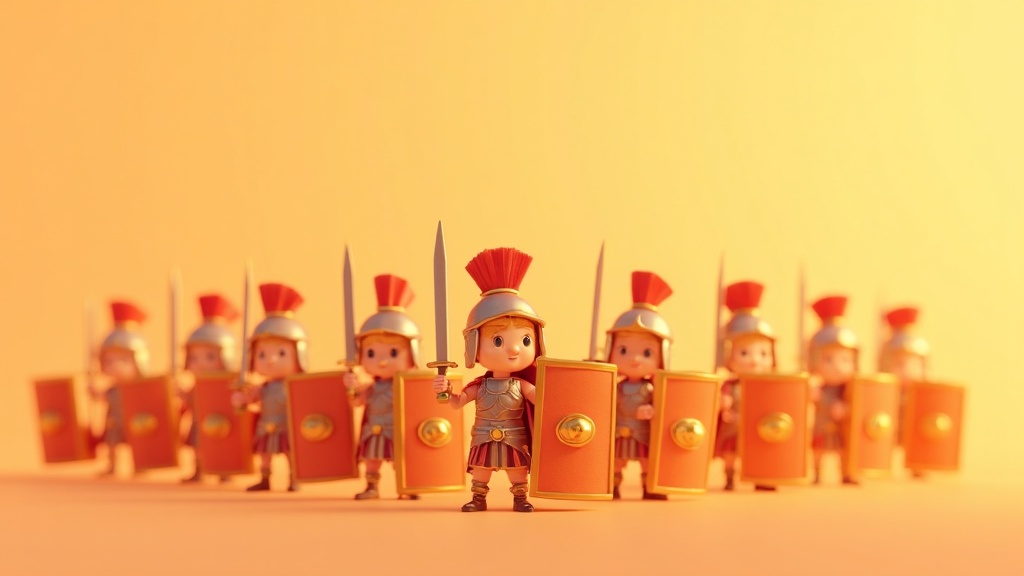

The Roman conquest was achieved through the highly disciplined Roman Legion, the main fighting unit of the Roman army. These professional soldiers trained rigorously, sometimes marching 40 km a day! This teamwork and endurance allowed Rome to build its massive ancient empire.
Did you know that the little city of Rome, way back in the day, grew into an ENORMOUS empire that stretched all around the sparkling Mediterranean Sea? How in the world did they do it?
It wasn't magic, but it was close! The Romans had a secret weapon: their incredibly tough and smart army! From around 509 BCE when they became a Republic, the Romans started conquering their neighbors, first on the Italian peninsula, and then across continents. They fought amazing battles against rivals like Carthage, winning the famous Punic Wars to control the Western Mediterranean! This massive growth turned their small city-state into an empire that, at its peak around AD 117, covered over 5 million square kilometers and included places like Britain, France, Greece, and Egypt.

Mira says:
"It’s amazing that their army wasn't just about fighting! They were also master builders, creating roads and aqueducts even while conquering. That level of organization is a superpower in itself!"
What Was the Roman Army Like?
Imagine an army where every single soldier was trained to be the best! That’s the Roman [Legionary](/learn/roman-army-for-kids). The main fighting unit was called a Legion, and it was packed with professional, super-disciplined soldiers.
They weren't just tough—they were smart! Roman training was super hard. Recruits learned teamwork, endurance, and exactly how to move together. They had to practice marching long distances, sometimes covering about 40 km (25 miles) a day!
Mind-Blowing Fact!
Roman soldiers had to carry a lot of gear—sometimes as much as 60 pounds (about 27 kg)! Because of all this weight, they sometimes marched slower than other armies, but they almost never stopped moving!
The Secret to Roman Strength: Organization and Discipline
The Romans understood that winning a battle is about more than just being strong; it’s about working like a perfectly oiled machine. They were masters of tactics.
Their main job was conquering, but their army also acted like a school for discipline and engineering, helping to spread Roman culture everywhere they went.
Typical time a soldier served
Roughly how many soldiers in one Legion
Decimation (beating to death every 10th man for cowardice)
How Did They Fight? Awesome Formations and Weapons!
Instead of fighting in one big, messy crowd, the Romans used clever formations that let them change their plan mid-battle. This flexibility was a game-changer for kids learning history!
One of their most famous moves was the Testudo, or Tortoise Formation.
The Amazing Testudo (Tortoise)
Imagine soldiers covering themselves completely with their shields! The outer soldiers held their shields to the sides, while the inner ones held theirs over their heads. This made a protective shell that could walk right up to enemy walls, safe from arrows.
The Deadly Weapons Kit
Every soldier had awesome gear. Their main stabbing weapon was the Gladius, a short, sharp sword perfect for close fighting.
They also threw the Pilum, a special spear designed so its iron point would bend when it hit an enemy shield, making the shield hard to use and impossible for the enemy to throw back!
💡 Did You Know?
The Romans sometimes divided their army into three lines based on experience: the *hastati* (new guys), the *principes* (men in their prime), and the *triarii* (the super-experienced veterans who were only called in for the toughest moments!).
🎯 Quick Quiz!
What was the famous 'Tortoise Formation' the Romans used for protection?
Who Helped Them Break Down Big Walls? Siege Machines!
Conquering an enemy city meant getting through huge walls! The Romans were expert engineers who invented incredible siege weapons to smash through defenses.
They built huge wooden towers, sometimes 22 meters high, called Siege Towers, to let soldiers fight the defenders right on top of the wall!
- Ballista: Looked like a giant crossbow and shot heavy bolts or stones a long way. The word 'ballistics' comes from this machine!
- Onager: A powerful catapult that hurled large rocks up to 450 meters using twisted ropes for tension.
- Battering Ram: A giant, heavy log, sometimes tipped with metal, swung to smash gates or walls—it signaled the start of a serious attack!
- Dirt Ramps: Sometimes, the best weapon was sheer hard work—building massive piles of earth to get the machines right up to the wall!
After conquering a place, the Romans were smart about keeping it. They often let local leaders stay in charge, as long as they paid their taxes to Rome. This policy, combined with building amazing roads to connect everything, helped keep their huge territory peaceful and connected for hundreds of years during the Pax Romana!
Questions Kids Ask About Ancient Rome
Keep Marching Onward!
From their disciplined march to their incredible siege engines, the Roman army had a winning formula! They didn't just defeat armies; they built a legacy that shaped languages, laws, and cities for centuries. Keep exploring to see what other amazing things this ancient powerhouse achieved!