The Kitty Hawk first flight, achieved by the Wright Brothers on December 17, 1903, was the first successful, controlled flight in a powered, heavier-than-air machine. Orville flew the Wright Flyer for 12 seconds, covering 120 feet. This event launched the Age of Aviation and inspires inventors today.
Imagine a world where getting around meant walking, riding a horse, or taking a slow boat. Sound boring? For centuries, humans dreamed of soaring like birds, but it stayed just a dream—until two determined brothers changed everything!
On December 17, 1903, near Kitty Hawk, North Carolina, brothers Orville and Wilbur Wright achieved something no one had ever done before: they made the first successful, sustained, and controlled flight in a heavier-than-air, powered machine! This incredible invention, called the Wright Flyer, was the start of the Age of Aviation. Learning these Kitty Hawk first flight facts for kids shows how hard work and smart thinking can make the impossible happen!

Mira says:
"Wow! That first flight was super short—only 12 seconds—but it opened up the whole sky! I wonder how much faster airplanes are today compared to the Wright Flyer's top speed of 6.8 miles per hour!"
What Was the Wright Flyer Anyway?
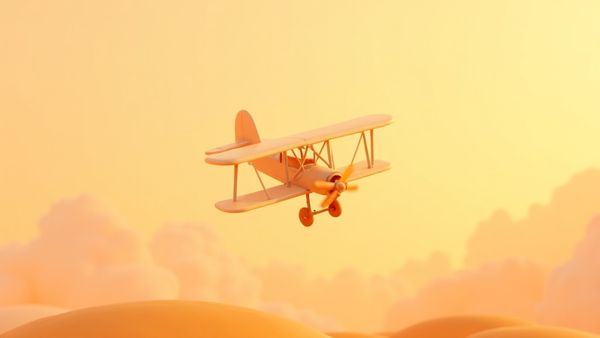
The amazing machine that made history was called the Wright Flyer, though sometimes people just call it the Kitty Hawk plane. It wasn't anything like the sleek jets we see today! It was a biplane, which means it had two main wings stacked one above the other for extra lift.
It had a wooden frame made from strong, light woods like spruce and ash, and the wings were covered with a special cotton fabric, kind of like sailcloth! It didn't have wheels for landing either—it took off from a special wooden launching rail and landed right on the sand!
Mind-Blowing Fact!
The Wright brothers didn't just wake up one day and build a plane! Their interest started way back in 1878 when their father brought home a small, rubber-band-powered toy helicopter!
First Flight Stats: How Did They Do It?
The morning of December 17, 1903, was chilly and windy at Kill Devil Hills, near Kitty Hawk. The brothers flipped a coin to see who would pilot the very first attempt. Orville won the coin toss!
At 10:35 AM, Orville lay flat on the lower wing and started the engine. The Flyer taxied down the launching rail, and then—lift off! They proved that human flight was possible with their machine.
(Orville Piloting)
(About 36 meters)
(Slower than a fast jog!)
(With Wilbur flying the longest)
How Did They Control the Flying Machine?
Many people before the Wrights tried to fly but failed because they couldn't steer! The Wright brothers realized that flying a plane wasn't just about going up; it was about control. This is where their bicycle shop experience helped them!
They invented the brilliant system called three-axis control. This meant they could control the plane up-and-down (pitch), left-and-right rotation (roll), and side-to-side turning (yaw).
The Secret to Steering: Wing Warping
To control the 'roll' (tilting side-to-side), the Wrights used a technique called 'wing warping'. They designed the Flyer so the pilot could slightly twist the wings. If the pilot twisted the left wingtip down and the right wingtip up, the plane would bank (turn) to the left, just like a bird uses its wings to steer!
💡 Did You Know?
The very first flight was only the *first* of four flights that day! The longest and most successful flight was the last one, piloted by Wilbur, which covered 852 feet in 59 seconds!
🎯 Quick Quiz!
What did the Wright brothers use to make their plane go up and down (pitch)?
Why Did They Choose Kitty Hawk?
The Wright brothers didn't pick Kitty Hawk, North Carolina, by accident! They needed a place that would help them with takeoff, landing, and testing their glider designs.
Here are the three main reasons they loved Kitty Hawk:
- Steady Winds: Kitty Hawk had strong, constant ocean breezes that helped the light plane get airborne.
- Soft Sand: If they crashed (which happened sometimes!), landing on the sandy beach was much safer than landing on hard ground.
- Seclusion: It was a remote spot, so they could test their secret invention away from crowds and people who might try to copy their ideas.
Sadly, after that amazing fourth flight, a big gust of wind knocked the Wright Flyer over while it was sitting on the sand, severely damaging it! It never flew again, but don't worry—the original Wright Flyer is now carefully preserved and displayed at the Smithsonian National Air and Space Museum in Washington, D.C., so everyone can see the machine that launched the age of flight for kids and adults alike!
Questions Kids Ask About Inventions
Keep Looking Up!
From a 12-second hop to flying across continents—all that progress started with Orville and Wilbur's courage to test their ideas. Keep being curious, keep asking questions, and who knows what amazing invention *you* might dream up next!