
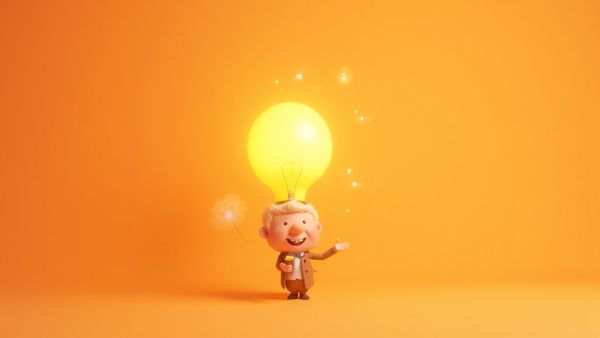
Thomas Edison was a prolific American inventor nicknamed the 'Wizard of Menlo Park' who changed modern life through electrical innovation. He earned an incredible 1,093 U.S. patents! His work brought electric light and recorded sound to homes, making the world a brighter and more connected place for everyone.
What if you woke up one morning and suddenly, *poof*, all the lights in the world stopped working? No lamps, no streetlights, just darkness! Scary, right?
Luckily, we have amazing inventors like Thomas Edison to thank for making our world bright! He was born on February 11, 1847, in Milan, Ohio, and grew up to become one of history's most famous inventors, earning an incredible 1,093 U.S. patents! His curiosity was so huge that people nicknamed him the “Wizard of Menlo Park.” For kids learning history, Edison’s story shows how one person's hard work can change *everything* for the better!

Mira says:
"Wow, Finn! Think about it: Edison didn't just invent *one* thing; he built systems! He didn't just make a light bulb work for a second—he made one that lasted for *hours*! That's what real inventing is about!"
What is an Invention Lab, and Why Was Edison's Special?
Before Thomas Edison, inventors often worked alone in small sheds or workshops. They might have a great idea, but finishing it and figuring out how to sell it was tough.
Edison changed this by creating the first true industrial Research and Development (R&D) lab at Menlo Park, New Jersey, in 1876! This wasn't just a place to tinker; it was like a high-tech science factory for his time.
At this lab, Edison gathered a big team of smart people—scientists, engineers, and mechanics. They all worked together on big, complicated projects. Edison’s goal was to invent things that people could actually use every day, not just cool gadgets that no one knew what to do with.
Mind-Blowing Fact!
Even though he is famous for the light bulb, Thomas Edison actually got his very first patent in 1869 for an automatic vote recorder! (Spoiler alert: Politicians didn't buy it!)
The Amazing Stats of a Super Inventor
Edison’s mind was always buzzing with ideas! He didn't just invent a few things; he had a goal to have a minor invention every ten days and a major one every month!
His total count of patents is mind-blowing. While the exact number can vary slightly based on what is counted, he was awarded 1,093 U.S. patents in his lifetime and 2,332 patents worldwide!
In the United States
Worldwide
Invention Date
Life of Early Bamboo Filament Bulb
How Did Edison Make the Light Bulb Practical?
Many people tried to invent an electric light before Edison, but their bulbs burned out in just a few minutes! Edison knew he needed three things to make it work for homes and streets.
Step 1: Finding the Right Material (The Filament)
The filament is the tiny, thin thread inside the bulb that glows. Edison and his team tested over 3,000 different materials! They finally found that a thin piece of carbonized bamboo worked best, lasting for over 1,200 hours!
Step 2: Making a Better Vacuum
Air makes things burn up quickly. Edison used a special pump to suck almost *all* the air out of the glass bulb, creating a great vacuum. This kept the tiny bamboo filament from burning out fast.
Step 3: Building the Power System
A light bulb is no good without electricity! Edison invented the electric power distribution network. In 1882, he opened the Pearl Street Station in New York City, the world's first central power plant! This let him send electricity reliably to many buildings.
💡 Did You Know?
Believe it or not, the phonograph—the first machine to record and play back sound—was invented in 1877, *before* Edison perfected his long-lasting light bulb! It was actually his favorite invention!
🎯 Quick Quiz!
What was Thomas Edison's famous nickname from his hard work at the lab?
Who Else Did Edison Work With?
Edison knew he couldn't do it all alone. He was an amazing leader who encouraged teamwork. He relied on many talented people to help make his ideas real.
One person who helped him was Lewis Latimer, who invented a better way to make the carbon filament stronger. Another was Edward H. Johnson, who helped bring electricity to homes.
- The Phonograph (Record Player): The first machine to capture and replay voices and music on tinfoil or wax cylinders.
- The Motion Picture Camera (Kinetograph): This helped start the entire movie industry!
- The Alkaline Storage Battery: An early version of the powerful, rechargeable batteries we use today.
- The Carbon Microphone: He made Alexander Graham Bell's telephone sound much louder and clearer!
Thomas Edison’s famous saying tells us his secret: “Genius is one percent inspiration and ninety-nine percent perspiration.” This means that even the best ideas need tons of hard work and testing to actually change the world!
Questions Kids Ask About Inventions
Keep That Curiosity Burning Bright!
From powering up your home to letting you listen to your favorite songs, Thomas Edison’s spirit of never giving up—even after thousands of tries—still lights up our lives today! What will *you* invent?