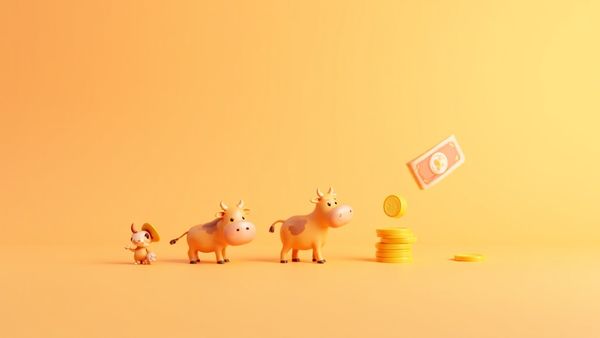
Before money, people used barter, trading items directly. The concept of money first emerged around 9000 BC when livestock, like cows, served as a basic medium of exchange. This solved the difficulty of trading exactly what you needed!
Have you ever wondered how you buy your favorite candy or video game today? You use money! But wait—who actually invented this cool stuff we call currency?
It might seem like money has always been around, but it hasn't! Long, long ago, people didn't have dollars or euros. They had to trade things directly, a system called bartering. The concept of money first popped up around 9000 BC when people started using things like livestock as a medium of exchange. Imagine trying to buy a small toy with half a cow—that's tricky! Over thousands of years, people kept inventing new, easier ways to trade, leading us right to the coins and paper we use today.

Mira says:
"It's amazing how much work it took to get from trading a sheep for a basket to just tapping a plastic card! Money is one of history's greatest inventions for making life easier for everyone!"
What Was Life Like Before Money? The Barter System!
Before money, people used a system called barter.
Bartering means you trade something you have for something you want. If a farmer had too many apples and needed shoes, he had to find a shoemaker who really, *really* wanted apples! This meant you had to have a 'coincidence of wants,' which could take a long, long time.
Things like grain, salt, tools, and even livestock like cows or sheep were used as early trade items.
Mind-Blowing Fact!
In some ancient cultures, like the Aztecs in Mexico, cocoa beans were used as a form of currency! That's like paying for a comic book with a fancy chocolate bar today!
The First Real Money: Commodity Money and Shells
Because bartering was so hard, people started agreeing that certain *things* were valuable enough to trade anytime. These were called commodity money—items that had value all on their own.
One of the most popular early forms of money was the cowrie shell. These beautiful, small shells, found in the Indian and Pacific Oceans, were great because they were small, hard to break, and similar in size.
People started using cowrie shells as money around 1200 BCE in places like China!
The Big Change: Inventing the Coin!
Imagine trying to trade a giant rock for a tiny piece of bread—it’s not going to work! People needed something easy to carry and divide. That’s where metal came in!
The very first official metal coins were invented in the ancient kingdom of Lydia (which is now part of modern Turkey) around 650 BC!
These first coins were made from a naturally occurring mix of gold and silver called electrum. They were often crudely shaped like beans and stamped with a royal symbol, like a lion, to show they were official and had a reliable weight.
💡 Did You Know?
The idea of the coin was so good that it spread fast! The Greeks adopted it next, and then the Romans made it even more popular, creating the first society where almost everyone used coins for daily shopping!
How Coins Helped Trade
Coins solved the biggest problems with bartering and shells: standardization! Because every coin was stamped by the government or ruler, everyone knew exactly how much it was worth. You didn't have to guess if a shell was the right size or if a cow was healthy enough!
From Heavy Metal to Lightweight Paper!
Coins were great, but what if you needed to buy a whole ship full of grain? Carrying thousands of heavy metal coins would be impossible! This is what happened in China.
Around the year 1000 AD, Chinese merchants started using paper money! They would deposit their heavy coins with trusted merchants or the government and receive a paper certificate that acted like a receipt or promise to pay.
This paper note let them trade without hauling a heavy sack of metal! The first official paper money came from the Chinese during the Song Dynasty in the 11th century.
- China (Around 1000 AD): Invented paper receipts for deposited coins.
- Europe (Later): Paper money slowly spread, with Sweden being one of the first European countries to issue it in 1661.
- Today: We use paper currency and coins, but also digital money we can't even touch, like when you use a parent's card!
🎯 Quick Quiz!
What was the system people used to trade goods directly before money was invented?
So, while no single person woke up one day and shouted, 'I invented money!' it was a slow, smart evolution. It went from cows to cowrie shells, to heavy metal coins, to lightweight paper, all to make trading fair and easy for kids and grown-ups everywhere!
Questions Kids Ask About Economics
Keep Exploring Financial History!
The story of money is really the story of human cleverness! Next time you spend a dollar, remember the thousands of years of history baked into that small piece of currency. What do you think the next big invention for paying will be?