In 2025, he got fewer Wikipedia pageviews than Arnold Schwarzenegger.
Every year, MIT's Pantheon project ranks history's most globally influential figures using the Historical Popularity Index (HPI). This peer-reviewed metric synthesizes Wikipedia presence across 25+ languages, article length, and sustained view counts over time to measure lasting global influence.
We compared each figure's 2025 Wikipedia views to what you'd expect given their historical importance. The gap tells you who's internet-famous beyond their legacy and who history is forgetting. +10x means 10x more attention than expected. -10x means 10x less.
We took their top 1,000 figures and compared their "importance" ranking to their actual 2025 Wikipedia pageviews. The gap between who history says matters and who we actually look up is striking.
The Forgotten Geniuses
Some of history's most consequential figures are practically invisible online. Not because they don't matter, but because pop culture has moved on.
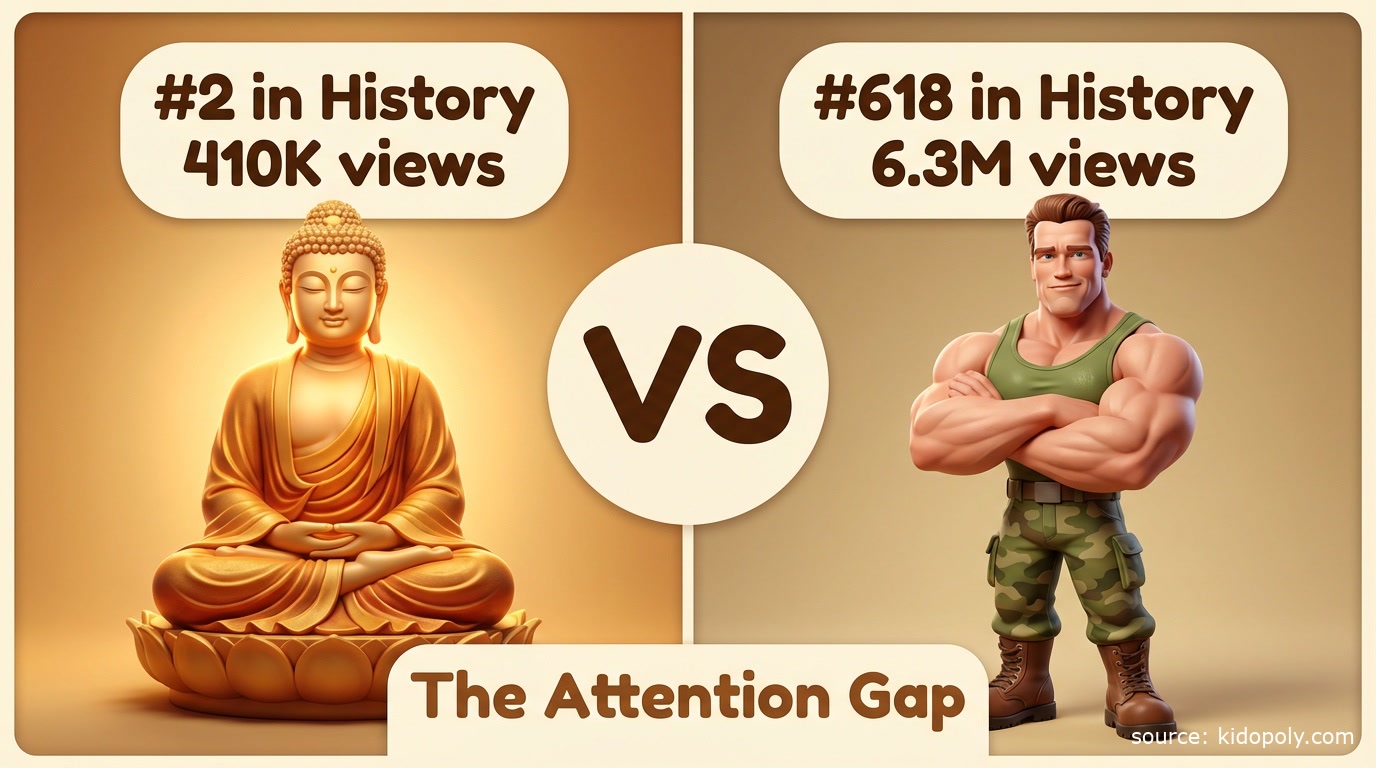
Schwarzenegger gets 15x more attention than Buddha, despite being ranked 616 places lower in historical importance. To be fair, Arnold was also a seven-time Mr. Olympia, Hollywood's biggest action star, and Governor of California. But Buddha's teachings shaped half a billion lives across 2,500 years. The gap is striking.
Muhammad ibn Musa al-Khwarizmi (#92 in importance) invented the algorithms that power every computer, phone, and search engine you use. He gets less traffic in a year than Donald Trump gets in a single day.
The pattern holds across the top 10. Note how modern political figures dominate attention while foundational thinkers fade:
| Figure | HPI Rank | 2025 Views | YoY |
|---|---|---|---|
| Muhammad | #1 | 4.4M | -10% |
| Buddha | #2 | 410K | -8% |
| Isaac Newton | #3 | 3.7M | +14% |
| Donald Trump | #4 | 34.5M | -32% |
| Genghis Khan | #5 | 4.0M | 0% |
| Cleopatra | #6 | 19.5M | -61% |
| Gandhi | #7 | 4.6M | -19% |
| Pope Francis | #8 | 16.7M | +355% |
| Mary | #9 | 1.5M | -16% |
| Beethoven | #10 | 2.0M | -12% |
Trump (#4 importance) gets 34.5 million views. Buddha (#2 importance) gets 410,000. That's an 84x difference. The gap reveals something uncomfortable: we've built an internet that amplifies controversy over wisdom.
The Most Overlooked Figures
Our analysis identified the figures with the largest gap between importance and attention. These people shaped civilization but barely register online:
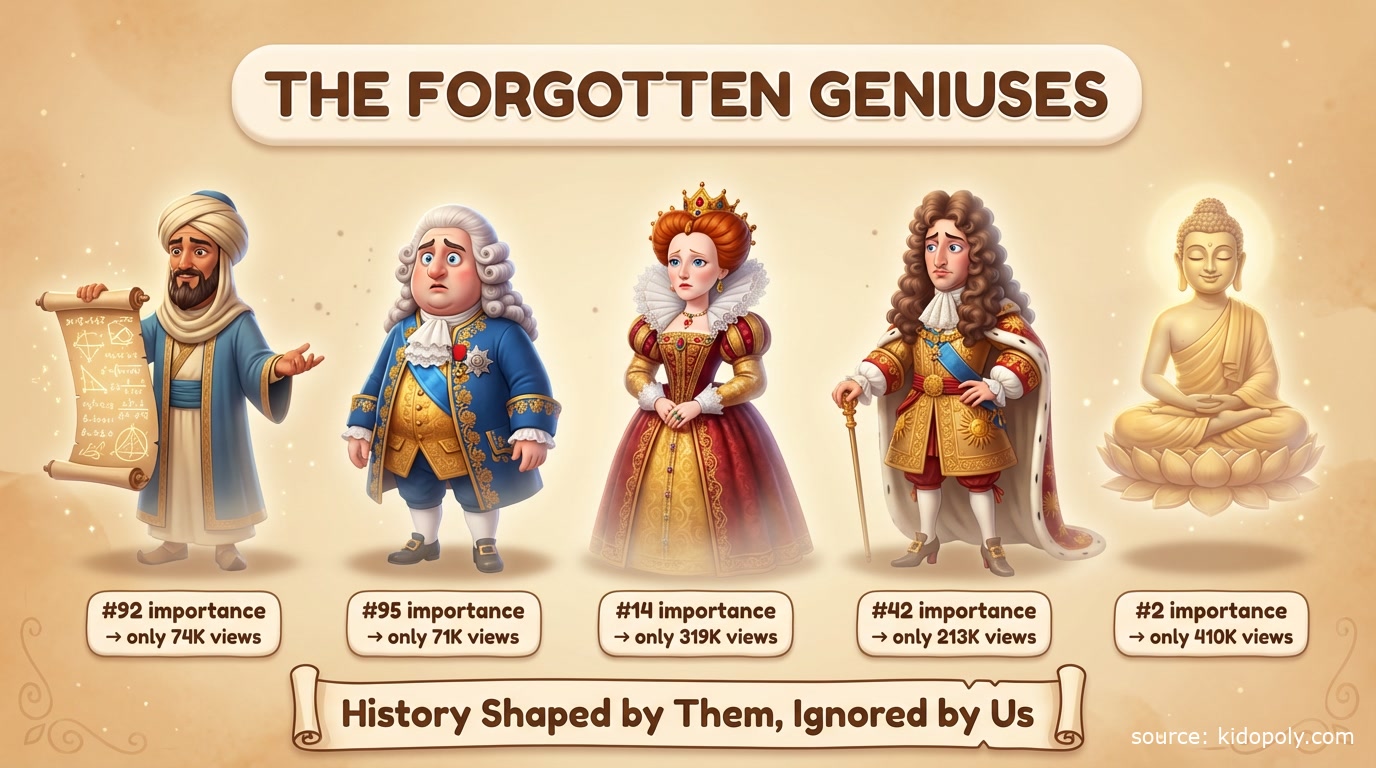
| Figure | HPI Rank | Views Rank | Gap | Views |
|---|---|---|---|---|
| al-Khwarizmi | #92 | #951 | -859 | 74K |
| Louis XVI | #95 | #946 | -851 | 71K |
| Elizabeth I | #14 | #730 | -716 | 319K |
| Louis XIV | #42 | #805 | -763 | 213K |
| Buddha | #2 | #637 | -635 | 410K |
Louis XVI, the king whose execution launched the French Revolution and reshaped Western democracy, gets 71,000 annual views. That's less than many YouTube cooking tutorials.
The Pope Effect
2025 was the year of the papacy. On May 8, the Catholic Church elected Pope Leo XIV, the first American pope in history. Robert Francis Prevost, a Chicago native who spent two decades serving the poor in Peru, became the 267th successor to Saint Peter.
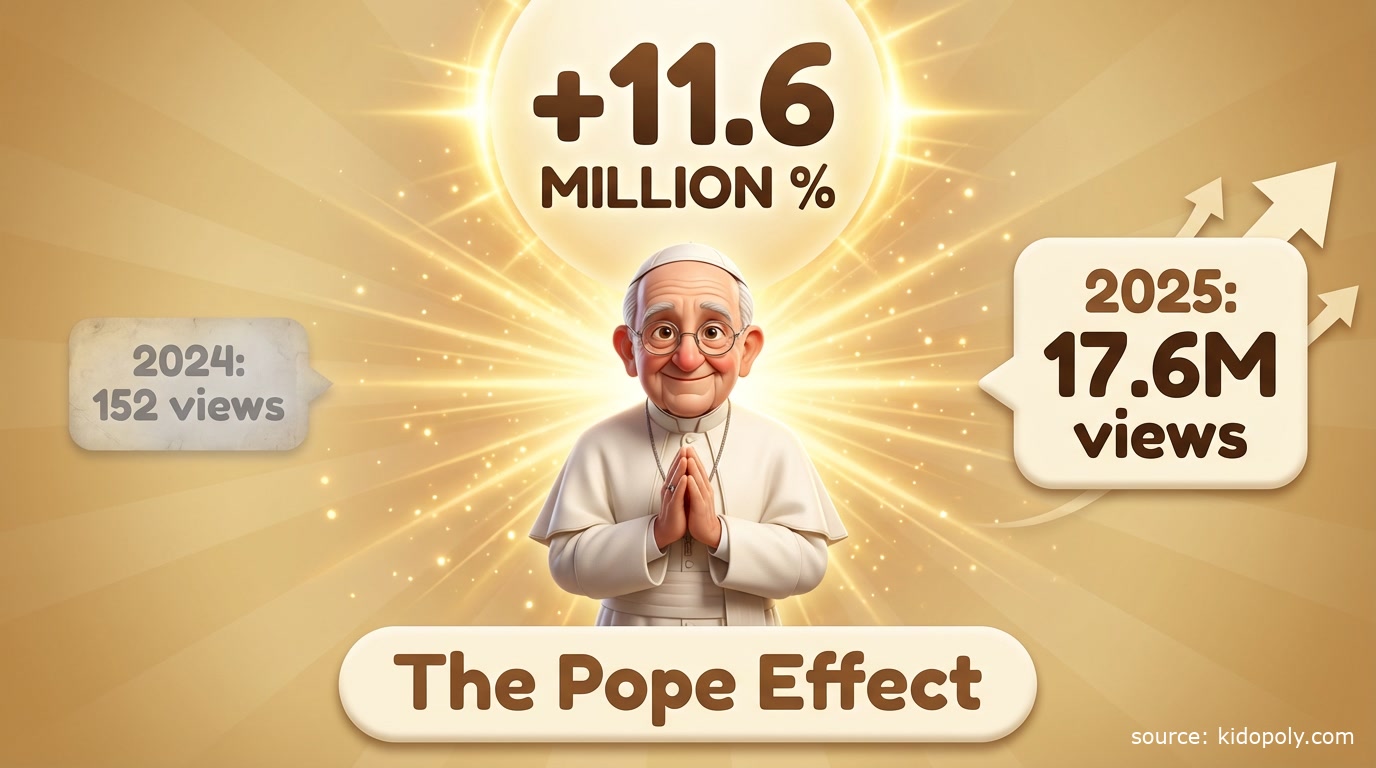
That's not a typo. Leo XIV went from 152 annual views in 2024 to 17.6 million in 2025. It's the single largest attention spike in our dataset by several orders of magnitude.
The papal election created a halo effect across Catholic history. People didn't just look up the new pope; they explored his predecessors and namesakes:
| Pope | 2025 Views | YoY Change |
|---|---|---|
| Pope Leo XIV | 17.6M | +11.6M% |
| Pope Leo XIII | 2.4M | +646% |
| Pope Francis | 16.7M | +355% |
| Pope John Paul I | 2.0M | +331% |
| Pope Benedict XVI | 5.5M | +245% |
| Pope Leo I | 759K | +358% |
Even Pope Leo I (who died in 461 AD) saw a 358% spike because people were curious about the "Leo" lineage.
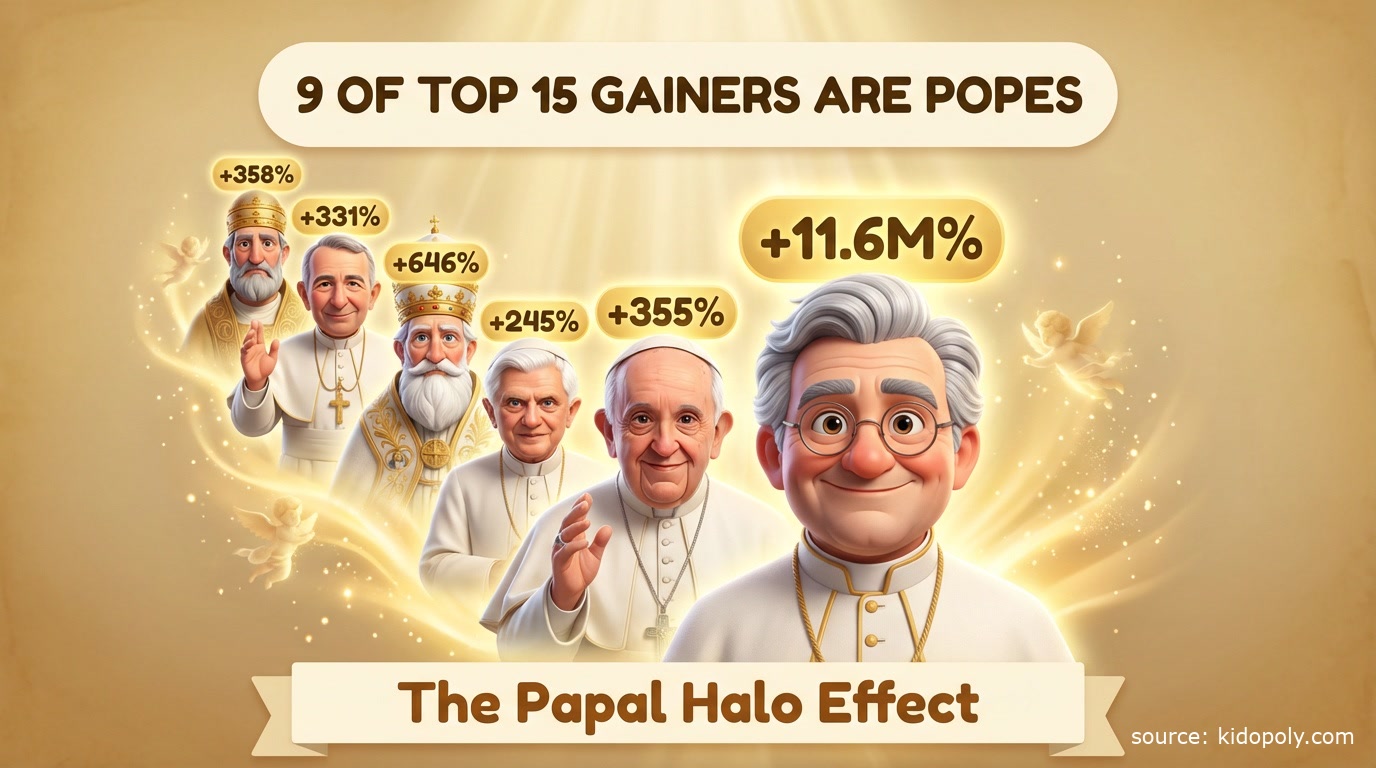
The 66 popes in our dataset generated 67 million pageviews. That's more than 2x the attention received by the entire 20th century's worth of Nobel Prize winners in our data.
Death Bumps Are Temporary
When famous people die, Wikipedia views spike. But what happens next?
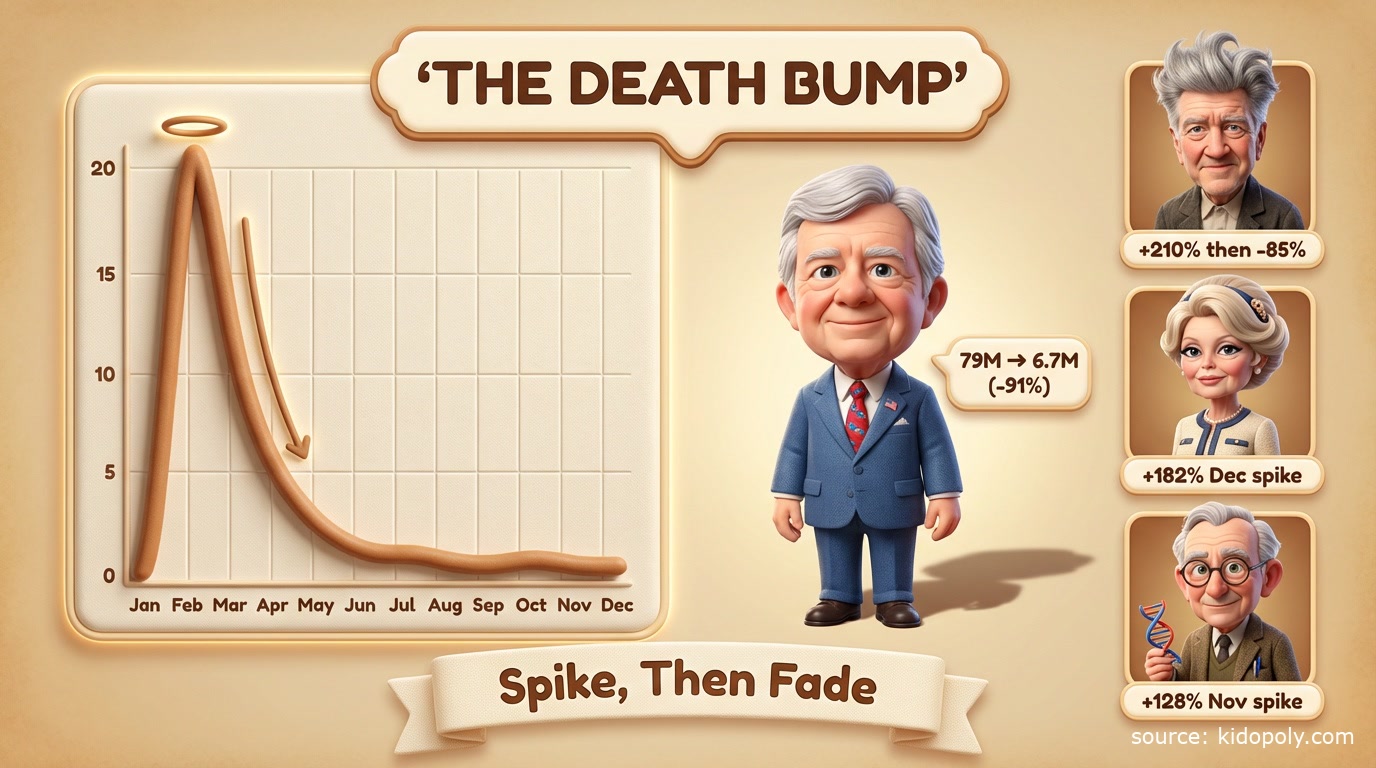
Jimmy Carter died on December 29, 2024, at age 100, becoming the longest-lived U.S. president in history. His death generated a massive spike in the final days of 2024 and early January 2025. But by spring, views had collapsed:
From 79.7 million views in 2024 to 6.7 million in 2025. His momentum within 2025 is also -78%, meaning views are still falling.
David Lynch, the legendary filmmaker behind Twin Peaks and Blue Velvet, died on January 16, 2025. His views surged +210% year-over-year. But his momentum within 2025 is -85%, meaning the spike was entirely concentrated in January. By February, people had moved on.
The pattern repeated at year's end. Brigitte Bardot, the French actress and animal rights activist, died on December 28, 2025. Her December views alone (2.7M) exceeded her entire 2024 total (1.4M). She finished the year up +182%, but almost all of that came in the final week.
James Watson, co-discoverer of DNA's double helix structure, died on November 6, 2025. His November spike (503K views) was 15x his normal monthly average. Year-over-year he's up +128%, but Q4 momentum of +537% tells the real story: it's a death bump, not sustained interest.
The "death bump" creates a paradox: figures can show strong YoY growth while simultaneously crashing in momentum. We call these post-peak figures.
The Biopic Effect
Hollywood has the same problem. Movies create attention spikes that evaporate quickly.
- J. Robert Oppenheimer: -69% YoY (Nolan's film was summer 2023)
- Bob Marley: -69% YoY (One Love biopic was 2024)
Christopher Nolan's Oppenheimer won seven Academy Awards and grossed nearly $1 billion worldwide. It made the physicist a household name for one summer. Now he's fading back into the academic obscurity he occupied before. This is the lifecycle of culturally-driven attention: spike, plateau, decline.
But 2025 also showed films can create new spikes. Hermann Göring, the Nazi leader, saw Q4 momentum of +254% after Russell Crowe portrayed him in Nuremberg, released November 2025. Alfred Hitchcock spiked +306% in Q4, driven by the 70th anniversary of Alfred Hitchcock Presents and a major 4K restoration box set. And Bruce Lee surged +663% Q4 amid buzz around Ang Lee's upcoming biopic starring his son Mason Lee, pushing Bruce Lee to +116% YoY despite no film actually releasing.
Who's Actually Trending Up?
The good news: some figures are building sustained momentum, not just spike-and-crash patterns:
| Figure | 2025 Momentum | YoY Change | Why? |
|---|---|---|---|
| Sophocles | +24% | +57% | Athens Epidaurus Festival 50th anniversary |
| William the Conqueror | +67% | +39% | Unknown driver |
| Benjamin Netanyahu | +32% | +18% | Ongoing news coverage |
| William McKinley | -56% | +42% | Trump's tariff hero |
Sophocles, the ancient Greek playwright, is seeing sustained growth throughout 2025. The Athens Epidaurus Festival celebrated its 50th anniversary with major productions of Antigone, Oedipus Rex, and Electra. Unlike death bumps, this interest built through the summer theatre season.
William McKinley is an interesting case: he's down -56% in momentum (January spike faded) but up +42% YoY overall. Trump's frequent praise of the "tariff king" and renaming Denali back to Mount McKinley drove curiosity about a largely forgotten president.
Ancient History Is Losing
Of all the eras we analyzed, ancient figures (born before 0 CE) are the only group with a negative average year-over-year change.
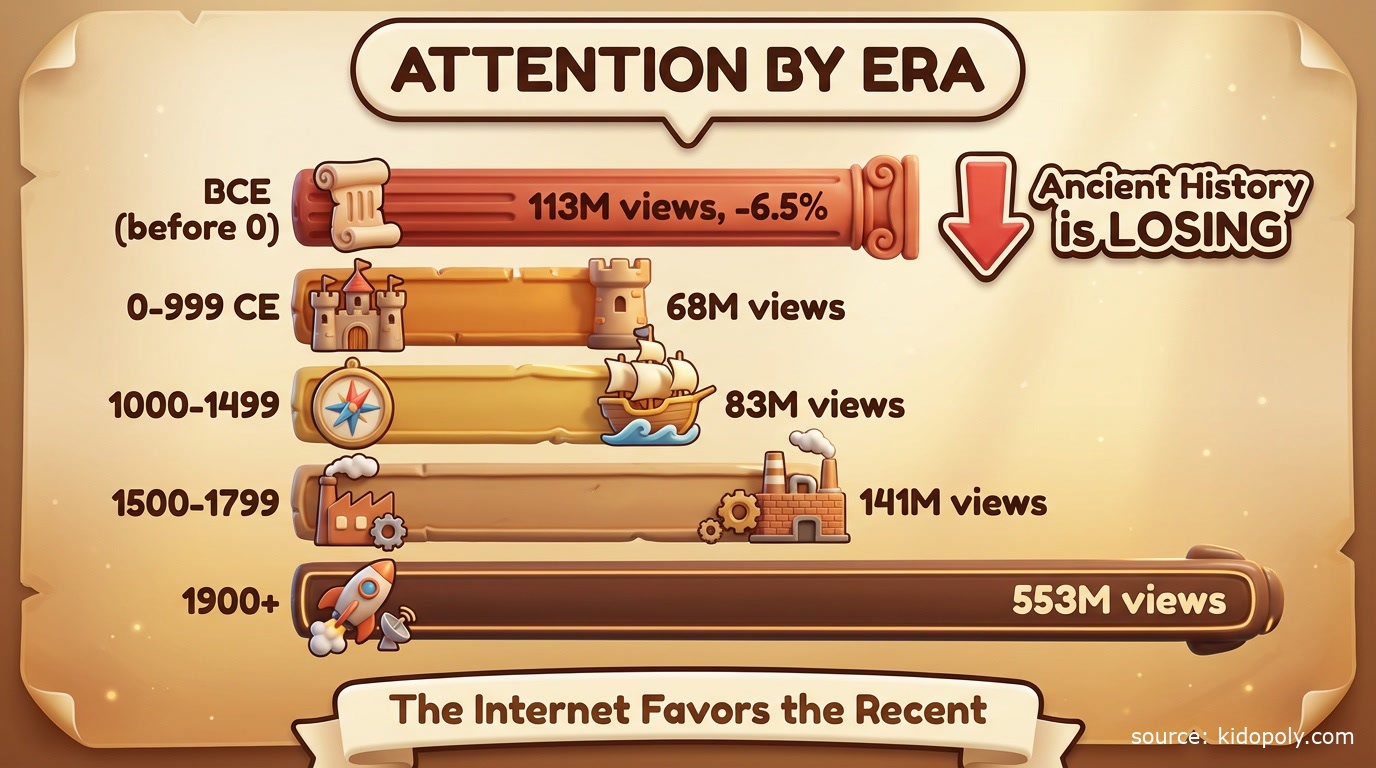
Here's how attention breaks down by era:
| Era | Figures | Total Views | Avg YoY |
|---|---|---|---|
| BCE (before 0) | 121 | 113M | -6.5% |
| 0-999 CE | 108 | 68M | +2.6% |
| 1000-1499 | 121 | 83M | +10.7% |
| 1500-1799 | 200 | 141M | +6.4% |
| 1800-1899 | 250 | 286M | +3.4% |
| 1900+ | 200 | 553M | varies |
The 1900+ era shows a massive skew due to Pope Leo XIV's unprecedented spike, but even without that outlier, modern figures dominate attention.
Cleopatra's Collapse
The biggest casualty? Cleopatra.
That's more than Newton, Einstein, and Gandhi combined. She went from 50.4M views in 2024 to 19.5M in 2025.
What happened? In 2023, Netflix released Queen Cleopatra, a controversial docudrama that sparked heated debate about historical representation. The controversy drove enormous curiosity. Egypt's government protested. Lawyers filed complaints. The series became one of Netflix's most talked-about releases.
By 2025, the controversy faded. Without fresh cultural relevance, Cleopatra's views returned to baseline. She's still #6 in importance and still gets 19.5 million views, but the trajectory shows how quickly ancient figures can lose ground when they're not actively promoted by pop culture.
Other ancient figures in decline:
- Moses: -37% YoY
- Alexander the Great: -33% YoY
- Confucius: -23% YoY
This pattern suggests ancient history needs constant cultural reinforcement (films, books, curriculum) to maintain public attention. Without it, these figures slowly fade from collective memory.
The Internet's Favorites
Some figures resonate far beyond what historical metrics would predict:
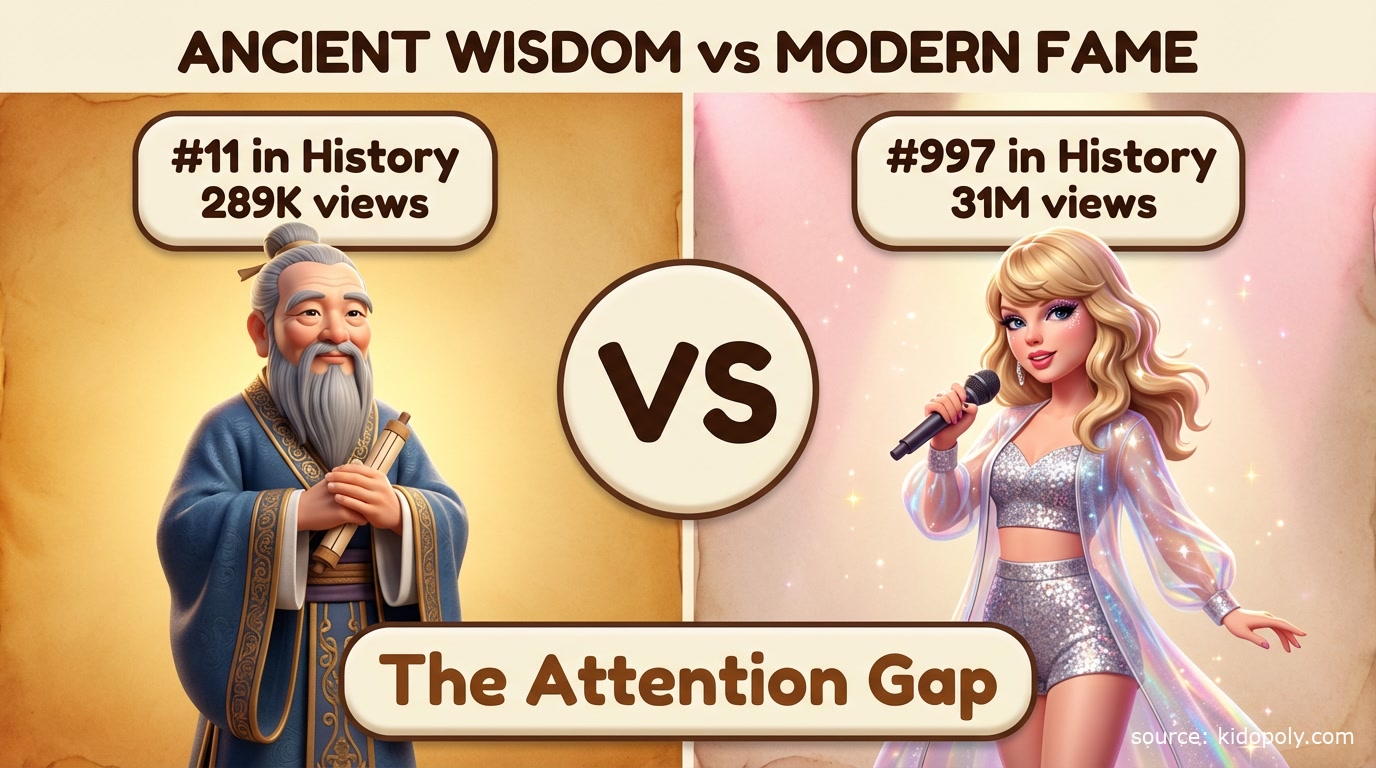
Musk is ranked 270 places lower than Newton but gets 7x more attention. His momentum is -79%, meaning his views were heavily concentrated in January 2025 (around the presidential inauguration) and have declined since.
The Most Over-Indexed Figures
These figures capture outsized attention relative to their historical ranking:
| Figure | HPI Rank | Views Rank | Gap | Views |
|---|---|---|---|---|
| Al Capone | #992 | #122 | +870 | 2.5M |
| Jackie Chan | #926 | #61 | +865 | 3.8M |
| David Lynch | #774 | #14 | +760 | 6.8M |
| Bob Dylan | #736 | #6 | +730 | 12.0M |
| Marilyn Monroe | #654 | #19 | +635 | 6.2M |
Bob Dylan, who surged +70% this year thanks to the A Complete Unknown biopic and ongoing cultural relevance, ranks #736 in importance but #6 in views. Al Capone, a gangster, outperforms most Renaissance artists.
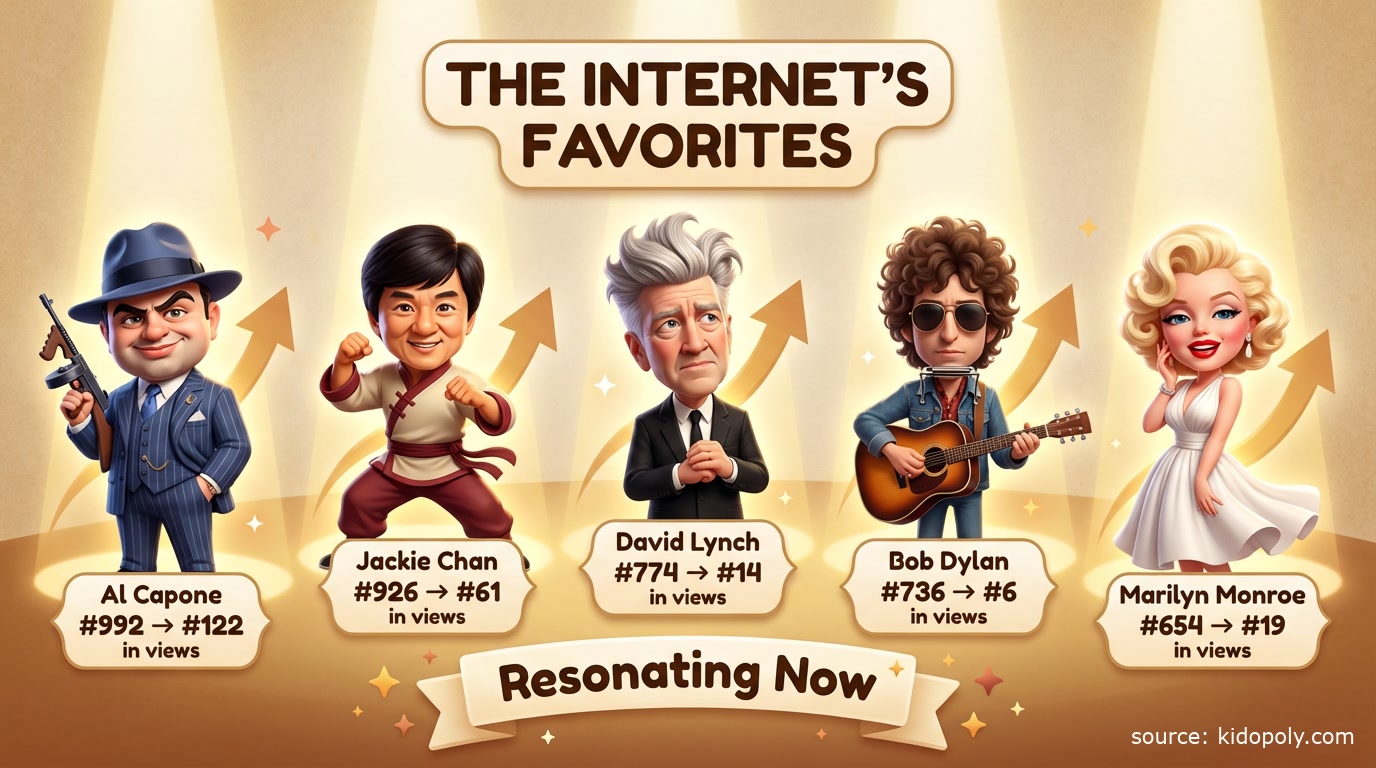
This isn't a criticism. These figures created work or personas that resonate deeply with living audiences. But it does reveal how the internet's attention favors entertainment and recent memory over foundational historical impact.
Attention by Occupation
Politicians dominate total views, but some occupations show interesting patterns:
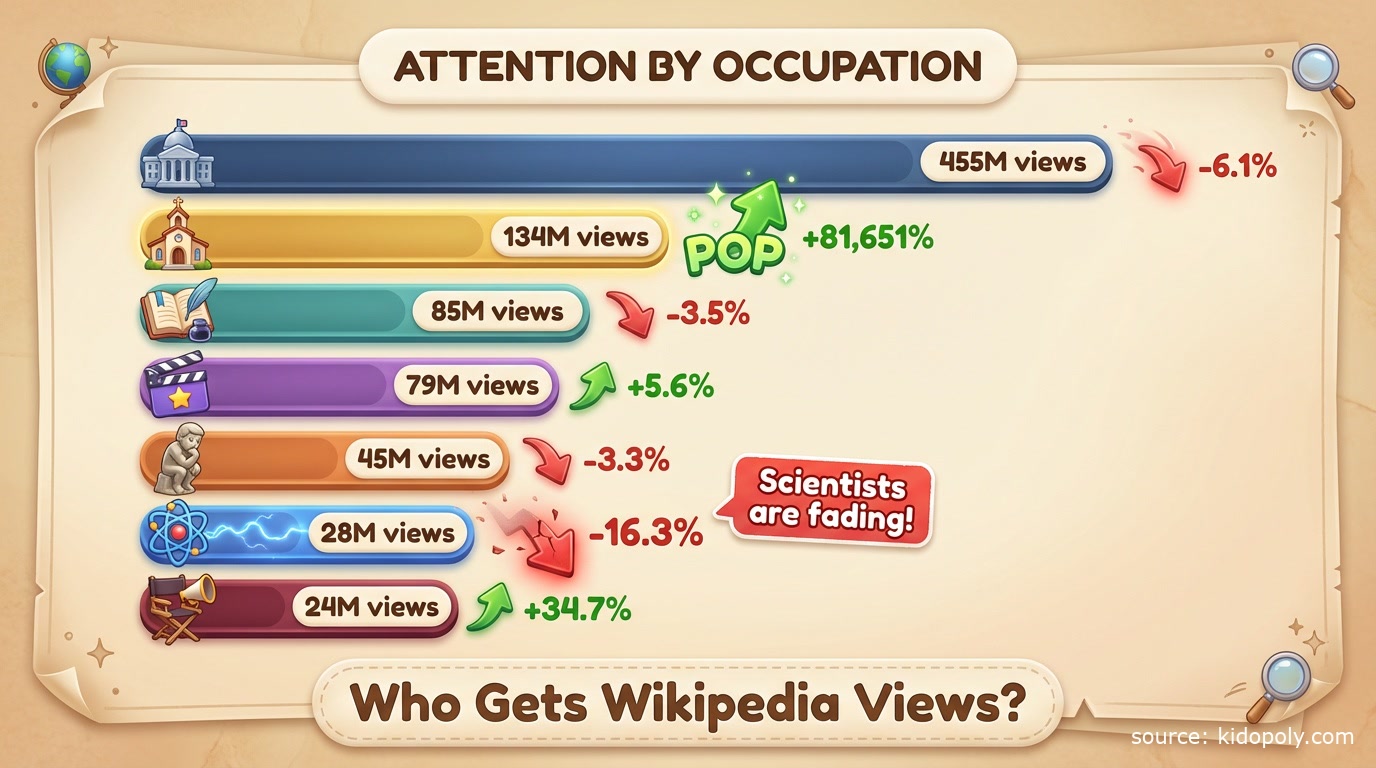
| Occupation | Figures | Total Views | Avg YoY |
|---|---|---|---|
| Politicians | 296 | 455M | -6.1% |
| Religious Figures | 142 | 134M | +81,651% (Leo XIV) |
| Writers | 108 | 85M | -3.5% |
| Actors | 25 | 79M | +5.6% |
| Philosophers | 62 | 45M | -3.3% |
| Physicists | 37 | 28M | -16.3% |
| Film Directors | 9 | 24M | +34.7% |
Physicists are in trouble. The 37 physicists in our dataset are declining faster than any other occupation at -16.3% YoY. This includes giants like Einstein, Bohr, and Heisenberg. The decline suggests waning public interest in science's foundational figures.
Film Directors are rising. The +34.7% average is driven partly by David Lynch's death spike, but directors as a category are holding attention better than most.
Actors turned positive. Last year actors were declining, but 2025's December deaths (Brigitte Bardot) and biopic buzz (Bruce Lee) pushed actors to +5.6% average YoY.
What This Data Tells Us
The attention gap isn't inherently bad. It reflects what we're curious about right now. Current events (elections, papal transitions, celebrity deaths) naturally dominate short-term interest.
But the data reveals structural patterns worth considering:
1. The Internet Has a Recency Bias
The 200 figures born after 1900 command 553 million views, nearly 5x more than the 121 figures from ancient times (113 million). Modern figures benefit from living memory, photographs, video footage, and ongoing news coverage. Ancient figures lack these advantages.
2. Controversy Drives Attention (Temporarily)
Cleopatra's 2023 Netflix controversy drove 50 million views in 2024. By 2025, it dropped to 19.5 million. The attention was real but not sticky. Controversy creates spikes, not sustained interest.
3. Education Gaps Become Attention Gaps
Al-Khwarizmi invented the algorithms that power modern computing. His name literally gives us the word "algorithm." Yet he gets 74,000 views annually. This suggests that figures not emphasized in standard curricula fade from public consciousness.
4. Pop Culture Is a Life Support System
Without movies, TV shows, or viral moments, historical figures slowly lose attention. Ancient history's -6.5% YoY decline suggests that without fresh cultural products (films, games, books), these figures will continue fading.
5. Wikipedia Reflects, It Doesn't Lead
Wikipedia pageviews measure curiosity, not importance. When Jimmy Carter dies, people look him up. When Oppenheimer wins Best Picture, views spike. Wikipedia captures the world's attention, but that attention follows external events rather than creating them.
Questions Worth Asking
This research raises questions without easy answers:
- Are we teaching kids about the figures who shaped civilization, or just the ones with Netflix specials? If school curricula don't emphasize al-Khwarizmi or Louis XVI, where will students learn about them?
- When ancient figures fade from public memory, what cultural knowledge goes with them? The ideas of Buddha, Confucius, and Socrates underpin much of modern philosophy. If nobody reads about them, do those ideas persist?
- How do we keep the "forgotten geniuses" in the conversation? Is it the job of educators? Filmmakers? Algorithm designers? All of the above?
- Does attention even matter? Perhaps Buddha's ideas spread regardless of Wikipedia views. Perhaps historical importance operates independently of internet metrics.
We don't have definitive answers. But we think the questions are worth exploring.
That's partly why we made this research. And it's partly why we make a podcast that tries to make history as interesting as it deserves to be.
Explore the Full Dataset
We've made all 1,000 figures available to explore, filter, and download. Find your own stories in the data.
Open the ExplorerHistory's Not Boring
Our podcast makes history come alive for kids ages 4-12 with daily episodes about the world's most fascinating figures and events. Maybe together we can close the attention gap.
Listen to the Podcast