A Roman Legion was the main fighting unit of the Roman Empire, composed of tough, well-equipped citizen soldiers. A typical Legion had about 5,000 to 6,000 men organized into Cohorts and Centuries. Kids will learn how this discipline made them the most powerful ancient army.
Imagine an army so organized and tough that they could conquer almost the entire world around the Mediterranean Sea. Sound cool?
We’re talking about the incredible Roman Legions! These were the main fighting groups of the Roman Empire. A single soldier, called a legionary, had to be super tough, well-equipped, and part of a team that worked like clockwork. The Roman army was famous for its discipline and its powerful infantry—that means soldiers who fought on foot! They weren't just good at fighting; they were also amazing builders, constructing roads, forts, and even bridges as they marched. Learning about the Roman soldiers for kids is like discovering a real-life superhero team from thousands of years ago!

Mira says:
"Wow, Finn! If one fully equipped legionary carried up to 45 kilograms (almost 100 pounds) of gear, that’s like carrying a very big refrigerator on your back while marching 20 miles! No wonder they were called 'Marius' Mules'!"
What is a Roman Legion and Who Was in It?
Think of a Roman Legion as the ultimate super-squad! It was the biggest unit in the Roman army, made up entirely of Roman citizens who were ready to fight for Rome. During the time of the famous Emperor Augustus, a typical legion had about 5,000 to 6,000 soldiers.
But how did they organize so many people? The legion was broken down into smaller, mighty groups. The basic building block was the Century, which, confusingly, had 80 men, not 100! (It was named for an older style of fighting!) Ten of these Centuries made up a Cohort, and ten Cohorts made up the whole Legion.
The absolute top dog in the whole Legion was the Legate, a high-ranking general. But the real heroes on the ground were the Centurions—the tough officers who commanded each Century and led from the front!
Mind-Blowing Fact!
Even though they were called 'Centuries,' the group size changed over time! Early on, the number was different, but by the Imperial period, a Century was almost always 80 men, plus their leader, the Centurion. The first Cohort was even bigger, made up of double-sized Centuries!
The Gear of a Gladiator (Almost!): Roman Soldier Equipment
A Roman soldier’s gear was designed to make him a walking fortress! If you were a legionary, you looked amazing and were super protected. You definitely needed protection because you were fighting face-to-face with the enemy.
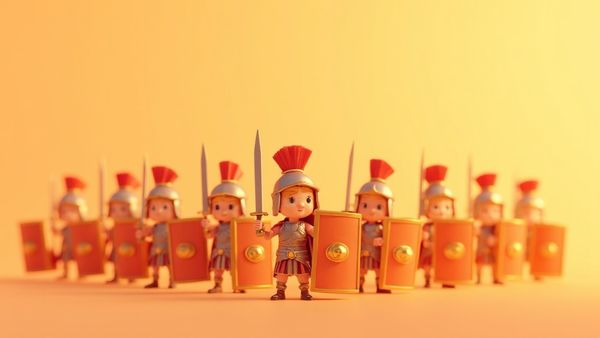
The helmet, called a Galea, kept your head safe. Your main body armor was the famous Lorica Segmentata, which looked like overlapping strips of iron armor held together by leather straps—it was strong but still allowed you to move!
Your shield, the Scutum, was a large, curved rectangle made of wood and covered in leather. It was so big it could protect you from your neck to your knees. You also carried a dagger (Pugio) and a short, double-edged stabbing sword called a Gladius—this was the main weapon!
Javelins thrown before fighting
In one Century
Minimum service time for a Legionary
Of gear carried (that's 66-99 lbs!)
How Did Roman Soldiers Get So Strong?
It wasn't magic; it was training, training, and more training! Roman soldiers were famous for marching long distances carrying everything they owned. This hard marching is why they got the nickname 'Marius’ Mules' after the general who changed the army's training style.
Every single day was about getting better. They practiced marching in formation, which meant they could cover about 36 kilometers (24 miles) in five hours! This was essential because an army that moves fast wins wars!
Daily Drills and Combat Practice
When not fighting an actual battle, the legion was always training. New recruits went through intense drills to learn how to move as one unit. They practiced with wooden swords and heavier-than-normal weapons to build strength.
They practiced throwing their heavy javelin, the Pilum, which was designed so that it would bend when it hit an enemy shield, making it impossible to throw back! Then, it was time for close combat with the Gladius, using quick, stabbing motions.
💡 Did You Know?
Roman legions were also expert construction workers! When they camped for the night, even if it was just for one night, they built a fortified camp complete with ditches and walls, making sure they were safe from surprise attacks. They built the foundations of the empire as they marched!
🎯 Quick Quiz!
What was the name of the short, double-edged stabbing sword used by Roman legionaries?
Why Did Everyone Want to Be a Roman Soldier?
Serving in the legions wasn't just about fighting; it was a path to a better life! A Roman citizen soldier signed up for a long time—usually 20 or 25 years of service.
When a soldier finished his long term, he received an 'honorable discharge' and amazing rewards. This kept the army full of experienced, loyal fighters who had a huge stake in keeping Rome safe and successful.
- A Plot of Land: Veterans were often rewarded with a piece of conquered land to farm, giving them a new home and income.
- A Cash Bonus: They also received a large sum of money, called a pension, to help them start their new life.
- Citizenship Perks: For non-citizens serving in the *Auxilia* (support troops), 25 years of service earned them—and sometimes their children—full Roman citizenship, which was a huge deal with many rights!
From their teamwork in the Centuries to the heavy gear they carried and the promise of land after service, the Roman Legionaries were truly one of history’s most effective fighting forces. They didn't just win battles; they helped build and secure the massive Roman Empire for hundreds of years!
Questions Kids Ask About Ancient Rome
Keep Marching with History's Not Boring!
Wasn't that an amazing look into the life of a Roman soldier? These guys were tough, organized, and dedicated! If you loved learning about the legions, sword fighting, and epic ancient armies, make sure to check out the next episode. History is definitely NOT boring when you have heroes like the legionaries to explore!